Operations | Monitoring | ITSM | DevOps | Cloud

The top three insights from the 2021 State of Database DevOps report

Last year was a year of unprecedented challenges for everyone in every part of the world and every industry, and it was also a year of big changes in the IT sector. The pandemic underscored the role of the IT department as an enabler and a critical part of the transition to remote working. While digitalization was well underway before 2020, no one could have predicted the acceleration the pandemic brought on.

Adding IaC security scans to your CI pipeline with Indeni

With CircleCI, there are many different CI/CD flows that can be automated. One such flow is the use of Infrastructure-as-Code (IaC) to build cloud environments. For example, you can use CircleCI to automate the process of building Terraform plans and applying them, in order to create massive production setups in AWS, Azure, GCP, and other cloud environments.

Integrating AppSignal With Microsoft Teams

We’re constantly looking for interesting integrations for our performance incidents, exception incidents, anomaly detection and uptime monitoring notifications, and our latest addition is an integration for Microsoft Teams. Microsoft Teams is a hub for team collaboration in Microsoft 365. It integrates people, content, and tools your team needs to be more engaged and effective.

How to achieve acceptance testing through abstraction

Beaker is a Puppet testing harness focused on acceptance testing via interactions between multiple (virtual) machines. It provides platform abstraction between different Systems Under Test (SUTs), and it can also be used as a virtual machine provisioner setting up machines, running any commands on those machines, and then exiting. Recently, Vox Pupuli, a collective of Puppet community authors, has taken over responsibility to care and feed Beaker for its continued widespread community use.

Using AWS Timestream for System Health Monitoring

Amazon Web Services (AWS) introduced a preview of Timestream in November 2018 before releasing the full version in October 2020. AWS Timestream is a time series database that can process trillions of events daily. It is faster and less costly than relational databases offered by AWS for processing time-series information. In this article, we will look at what Timestream can do compared to some other AWS databases, and how to use Timestream to help monitor the health of your system.

Monitoring and Tuning Open-Source Databases

By continuously running a well-built general-purpose database performance monitoring facility, organizations can gain constant visibility into the availability and responsiveness of their databases and database management systems (DBMSs). When such a tool is equipped with analytics to compare historical metrics against current values, administrators can immediately understand how current values and behaviors stack up against prior averages and typical baselines.

Do You Know Where Your Cloud Is? Understanding Shadow IT

The public cloud has greatly increased the flexibility of businesses everywhere. Need another petabyte of storage? You’re but a few mouse clicks or a couple lines of code away from allocating all those disks with effectively no lead time. At the same time, it makes it easy for business units, a functional organization, or a disgruntled vice president with a corporate card—who may be frustrated with your IT for various reasons.

Why the role of the CIO is constantly changing and challenging

Back in the days, the role of the CIO was relatively clear: the focus was on deploying, managing, and maintaining IT systems across the organization. The CIO’s responsibilities started to blur when end-users became more tech-savvy - around the millenium. Reasons were that ‘they can now get their own technology and don’t need IT to do it for them’. This even led to the much-repeated “death of the CIO meme”.

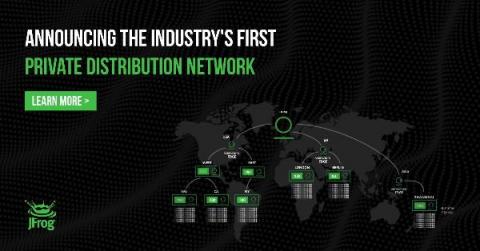
Announcing the Industry's First Private Distribution Network

Today, at our DevOps user conference swampUP, we were thrilled to announce a new groundbreaking innovation from JFrog: The industry’s first Private Distribution Network! Private Distribution Network (PDN) enables enterprises to easily set up and manage a secure, massively-scalable, hybrid distribution network for software updates.

What's New from JFrog: Binary Lifecycle Management at Scale

JFrog’s annual swampUp DevOps conference always brings new, exciting features to further our vision of accelerating releases through liquid software. This year was no exception, as JFrog CTO Yoav Landman and CPO Dror Bereznitsky revealed innovations for the JFrog DevOps Platform that enable end-to-end binary lifecycle management. Enterprise DevOps and large-scale modern application delivery require robust management of binaries, which are the building blocks of applications.