Operations | Monitoring | ITSM | DevOps | Cloud

Container security on IBM Cloud

If you’re running containers and Kubernetes on IBM Cloud, you can now enable the key security workflows of Sysdig Secure as a service within your IBM Cloud deployments. This makes it easier for you to implement security tools and policies to ensure your containers and your Kubernetes environment are protected and running as intended. The new container and Kubernetes security features are integrated into IBM Cloud Monitoring with Sysdig and offered as an additional service plan.

Kubernetes network policies with Sysdig

Microservices and Kubernetes have completely changed the way we reason about network security. Luckily, Kubernetes network security policies (KNP) are a native mechanism to address this issue at the correct level of abstraction. Implementing a network policy is challenging, as developers and ops need to work together to define proper rules. However, the best approach is to adopt a zero trust framework for network security using Kubernetes native controls.

How small changes to your SLOs can be SMART for your business - A narrative case study

In the second part of his "Choosing SLOs that are appropriate for our customers" blog, Adam Hammond, narrates a fictional case study through Bill Palmer, one of the protagonists of The Phoenix Project and shows "How small changes to your SLOs can be SMART for your business" In our previous blog, we discussed why you need to choose SLOs that are appropriate for your customers. We don’t always write out S M A R T and list our SLOs immediately. The process is organic, and it may take a while.

Secure Chaos Engineering on Kubernetes Clusters Without being a Noisy Neighbor

Get started with Gremlin's Chaos Engineering tools to safely, securely, and simply inject failure into your systems to find weaknesses before they cause customer-facing issues. Kubernetes is a powerful open source platform to build scalable, reliable systems, designed to be extensible and customizable for many use cases. Kubernetes provides the ability to scale individual pods, swap out runtimes, and control access to objects using namespaces.

Tracing with the Grafana Cloud Agent and Grafana Tempo

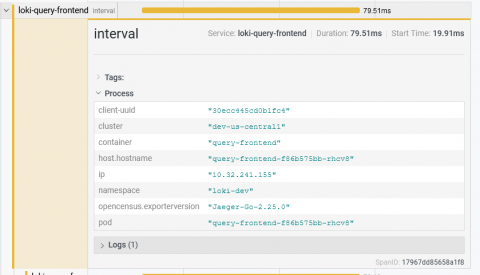
Back in March, we introduced the Grafana Cloud Agent, a subset of Prometheus built for hosted metrics. It uses a lot of the same battle-tested code as Prometheus and can save 40 percent on memory usage. Ever since the launch, we’ve been adding features to the Agent. Now, there’s a clustering mechanism, additional Prometheus exporters, and support for Loki. Our latest feature: Grafana Tempo! It’s an easy-to-operate, high-scale, and cost-effective distributed tracing system.

SquaredUp 5.0 is coming And it will be bigger and better than ever before!

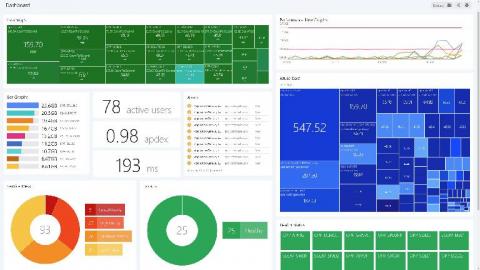
As the year draws to a close, we’ve got exciting news. In the new year, we will be launching SquaredUp version 5.0! So, what exactly is in this big, bold update, you ask? Expect a gorgeous new look and feel plus major improvements to our two most popular features – Open Access and Dashboard Designer. We’re also bringing you even more visualizations for your Web API integrations, so you can display data in the best possible way in your single pane of glass. The best part?

Shipping Sysmon Logs to Logz.io Cloud SIEM

System Monitor (Sysmon) is Windows’ service for monitoring activity and recording it to the Windows event log. It is the go-to for logging anything on a PC. Sysmon will immediately log events, capturing vital info. The driver for Sysmon will install as a boot-start driver, enabling capture of any and all events from the get-go. Now, you can send Sysmon logs straight to Logz.io Cloud SIEM.

HAProxy Log Sampling

Log Sampling is a powerful feature introduced in HAProxy 2.0 that lets you define a percentage of your logs to create a representative view of your data allowing you to minimize your costs. Log files are the key to observability. They can provide helpful information that can be used for debugging as well as analytics that can be used to understand how users interact with an application.

The Limitations of Lighthouse

Google Lighthouse helps you identify page performance issues. It generates an overall performance “score” to make you feel good (or bad) about your site’s speed. This score can be useful, but has some limitations. Lighthouse is an automated tool for assessing web page quality. It generates metrics for performance, SEO, accessability and more. Google has been promoting it as THE way to measure website quality.

How to Monitor Kubernetes Applications

Software companies large and small are embracing microservices as a superior approach to application development and management, compared to the earlier monolithic model. These software teams tend to reach out for containerization as their preferred way of packaging and shipping applications. Containers provide a lightweight encapsulation of any application, whether it is a traditional monolith or a modular microservice.