(This blog post is part of a 5 part series, titled “How to launch IoT devices”. It will cover the key choices and concerns when turning bright IoT ideas into a product in the market. Sign up to the webinar on how to launch IoT devices to get the full story, all in one place.) First part: Why does IoT take so long? Second part: Select the right hardware and foundations Third part: IoT devices and infrastructure
The tutorial for building a Raspberry Pi cluster with MicroK8s is here. This blog is not a tutorial. This blog aims to answer; why? Why would you build a Raspberry Pi cluster with MicroK8s? Here we go a little deeper to understand the hype around Kubernetes, the uses of cluster computing and the capabilities of MicroK8s.
Canonical today announced full enterprise support for Kubernetes 1.18, with support covering Charmed Kubernetes, MicroK8s and kubeadm. Committed to releasing in tandem with upstream Kubernetes, enterprises can benefit from the latest additions to enhance their day to day operations.
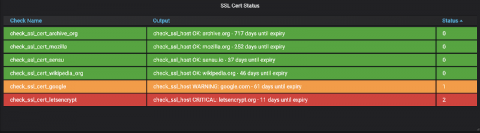
Uh oh, the site’s certificate has expired. How do we generate a new one? Where’s the private key? Which servers need the new cert? What even goes in the cert? If this sounds all too familiar, rest assured you’re not alone. Outages due to expired certs are far too common and it happens to sites of all sizes (one recent example includes Microsoft Teams going down for several hours due to an expired cert). Disruptions like this are entirely preventable with proper monitoring in place.
On March 16th, we announced our Customer Care Program, including four no-charge emergency response apps. We’ve already seen tremendous traction with the apps. As of March 25, nearly 1000 organizations have downloaded the apps. In addition, our amazing community has generated many new ideas, resources, tools, and stories. Some are best practices, some are specific to customers of the Now Platform®, and some come from ServiceNow partners who are helping with new apps, services, and strategy.
There are 1.3 billion websites out there in the great unknown and it’s hard not to think about what makes them different from one another. Why do users flock to one website and ignore the other completely? One major differentiator is, of course, content. I’m not going to dwell on what type of content is better. Another reason why users stick to one website over another is the user experience. Today we’ll be looking at a third major differentiator: Website Performance.
Longhorn is cloud-native distributed block storage for Kubernetes that is easy to deploy and upgrade, 100 percent open source and persistent. Longhorn’s built-in incremental snapshot and backup features keep volume data safe, while its intuitive UI makes scheduling backups of persistent volumes easy to manage. Using Longhorn, you get maximum granularity and control, and can easily create a disaster recovery volume in another Kubernetes cluster and fail over to it in the event of an emergency.
The global corporate landscape is on the brink of a complete premises lockdown in light of the COVID-19 crisis. Service disruption is inevitable, and enterprises’ business continuity plans are being put to the test. Despite this challenge, it’s heartening to see companies across nations take quick steps to ensure the health and safety of their employees during these trying times.
We’ve been working on something big. We’re building Request Metrics, a new service for web performance monitoring. TrackJS is a fantastic tool to understand web page errors, but what if your pages aren’t broken, just slow? What if the checkout page takes 10 seconds to load? What if that user API is slowing down from your recent database change? What pages have the worst user experience? Request Metrics will tell you that.