Operations | Monitoring | ITSM | DevOps | Cloud

The September 30, 2026 Railway Outage

Railway-hosted domains returned HTTP 404 to new connections in all four Railway regions on September 30, 2026, for about five minutes between roughly 07:35 and 07:40 UTC. This happened after a new version of Railway's routing service went live before the database schema change it depended on had been applied.

Agentic AI or CLM Compliance? A Buying Test for Financial Services

Consider a hypothetical bank negotiating a technology supplier agreement. An AI agent spots a change to the audit-rights clause, proposes replacement language and prepares the contract for approval. The review looks faster. Then someone asks which policy version the agent used, whether the replacement was approved, and what prevents the unsigned draft from becoming the operational record. Those questions should shape the buying decision.

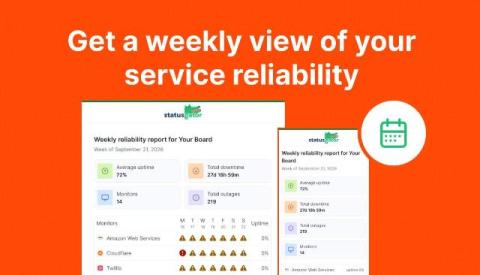
Get a weekly view of your service reliability

StatusGator already keeps you informed as outages happen with status change notifications and Early Warning Signals. Now, you can also get a simple summary of how your services performed over the past week. We’ve added Weekly Uptime Reports, delivered directly to your inbox. Each weekly report gives you an at-a-glance view of your StatusGator board, including: This makes it easy to review the week without digging through individual incidents or notification emails.

HIPAA Wasn't Written for AI Agents. It Applies to Them Anyway

In short, healthcare is adopting AI agents faster than almost any other industry. More than 85% of Epic’s customers already use Epic AI, Epic’s Agent Factory will let every health system build agents of its own from 2027, and 43% of health systems were piloting agentic AI at the start of this year.

Intent-driven development: How to guide agents from idea to implementation

Intent-driven development (IDD) is an approach to AI-assisted software development where teams make the desired behavior, constraints, and criteria for success explicit, then give an agent freedom to determine how to achieve the result. As agents take on larger and more autonomous development and maintenance tasks, the implementation itself becomes easier to replace. The important question is whether the software still behaves the way the team intended.

Building Production-ready AI Infrastructure? Start With the Network

AI workloads depend on fast, secure, and scalable access to data across on-premises systems, colocation, cloud platforms, and GPU environments. Here’s how private connectivity can help enterprises move from AI proof of concept to production-ready infrastructure. AI pilots tend to be forgiving. Production isn’t. In the early stages, a team can usually get by with a simple path into a GPU environment, enough bandwidth to test an idea, and a security model that suits a limited group of users.