CloudSpend: Cloud cost management With the rising popularity of a hybrid cloud strategy, businesses need to keep their spending in check. To provide high availability for its data, more organizations have started to adopt a multi-cloud strategy, and they have choices for cloud platforms. AWS and Azure accounted for the lion’s share of the market in 2022. With their expertise in providing IaaS, this has also often resulted in disparate deployments with respect to cost estimation and control.
Data is the lifeline of modern businesses, and losing it can have serious consequences. That’s why backup and recovery strategies are crucial for any organization. Azure Storage is one of the most reliable and secure cloud storage solutions available, making it an excellent option for storing backups. In this article, we will explore the benefits and challenges of using Azure Storage as a backup location and provide you with a step-by-step guide to set up and manage your backups.
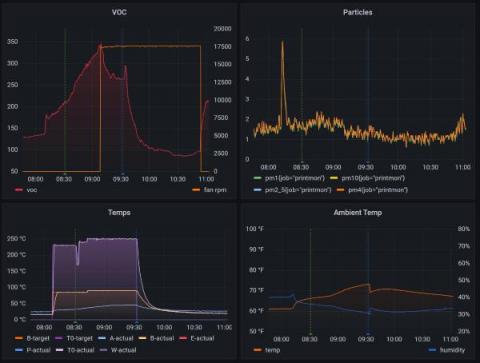
I lead the Grafana Loki project here at Grafana Labs, and I’ve always loved building things professionally and in my personal life, whether we’re talking about metalworking or coding — or, more recently, 3D printing. A couple years ago, I purchased my first 3D printer, a Prusa i3 MK3S+. I use it periodically to build functional items I use around my house in Upstate New York. For example, I recently decided to build a solar radiation shield for my outdoor weather station.
Budgets are a touchy subject for anyone, and there’s no one-size-fits-all approach. However, the work ITOps does is integral to the success of your organization, so being confident in building and defending your budget is crucial to getting the resources you need. So what does success look like when it comes to ITOps budgets? In our recent podcast episode from our series, That’s great IT, I sat down with global IT leader Nigel Peacock to discuss the best ways to justify your ITOps budget.
Users have been generating increasing amounts of data in the past few years, partly due to rapid digitalization since the pandemic. As a result, increasing numbers of analytics applications are capitalizing on these data assets. However, building scalable systems is no trivial task and incidents are inevitable. Complex systems generate data in the form of logs, traces, metrics, and more, which organizations often find themselves sprinting through. Such logs are a powerhouse of valuable information.
Monitoring is not a goal, but a path. Depending on the maturity of your project, it can be labeled in one of these six steps of the cloud monitoring journey. You will find best practices for all of them and examine what companies get from each one. From classic virtual machines to large Kubernetes clusters or even serverless architectures, companies have adopted the cloud as a mainstream way to provide their online services.
Grafana has been a staple visualization tool used alongside InfluxDB since its inception. With the release of InfluxDB Cloud powered by IOx, there is now a new way to integrate InfluxDB and Grafana: Flight SQL. Two of our engineers, Brett and Helen, have been working hard to create a new Grafana plugin called Flight SQL. This open-source plugin allows users to perform SQL queries directly against InfluxDB IOx and other storage engines compatible with Apache DataFusion.