Operations | Monitoring | ITSM | DevOps | Cloud

The latest News and Information on Observabilty for complex systems and related technologies.

Observability and Security for the AI Era

Datadog has always been driven by a broader vision of helping teams understand and operate complex systems. In this session, you’ll hear from Yrieix Garnier, VP of Product, and Hugo Kaczmarek, Senior Director of Product, as they share the latest updates across the Datadog product suite and discuss how that vision continues to shape the platform’s evolution and support the next generation of AI-driven applications.

The Observability Gap: Why Monitoring Data Should Drive Tests

Most teams already know a lot about production. They have dashboards. They have traces. They have alerts. They have enough telemetry to explain what happened after an incident and enough graphs to argue about it for the rest of the week. Then they go to test a change and start from scratch. The integration tests hit a hand-written mock that returns {"status": "ok"}. The load tests replay a CSV somebody exported months ago. Staging is close enough to production right up until it matters.

Observability Is Now a Boardroom Priority Even If Nobody Wants to Say It Out Loud

Executives rarely state the full truth publicly, but inside boardrooms the conversation has changed. Observability, once viewed as a technical capability deep within operations, has become a strategic requirement for understanding business performance. Leaders may not always use the term itself, yet they focus intensely on the outcomes it promises. Their environments have grown too fast, too fragmented, and too interdependent for traditional visibility approaches to keep pace.

Scary Things Happen in Production. Context Helps You Find Them.

Production is a rowdy place of chaos, especially at scale. When you have millions of requests per second flowing through your system, weird things are always happening. Outliers, unusual request patterns, spikes and pulses of traffic from unknown sources, port scanning…it’s all there. To the naked eye, it looks like noise. If you know what you are looking for…patterns emerge. The night sky: every dot is a request. Without intent, it's an undifferentiated field of light.

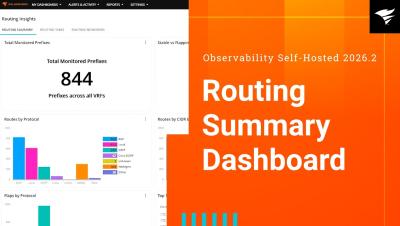
Smarter Alerts, Faster Root Cause, & Proactive IT Ops with SolarWinds AI Observability

Discover how AI is transforming IT operations with SolarWinds Observability. In this video, we showcase powerful new AI-driven features designed to help you detect issues faster, reduce alert noise, and stay ahead of performance problems across your entire stack. From applications and databases to networks, cloud infrastructure, and end-user experience SolarWinds AI delivers deep insights where it matters most.

Cribl Search Demo: Security Investigation

In this demo, Nate Zemanek , Staff Solutions Engineer, shows how Cribl Search runs fast investigations. As an open data platform, Cribl Search lets you pull data from multiple sources and query everything from a single pane of glass. You’ll see how to run fast queries with the new lakehouse engine, search historical data with a federated approach, and bring everything together for full context. Then, use Notebooks to collaborate and share findings across teams to understand what happened—faster.

How a Runtime Aware AI SRE Agent Transforms System Reliability

A runtime aware AI SRE extends existing AI SRE approaches by moving beyond telemetry correlation into runtime-validated reliability. While the majority of AI SRE tools accelerate incident triage using logs, metrics, and traces, they cannot confirm execution behavior if critical runtime signals were never captured. By generating on-demand evidence inside running services, AI SRES can eliminate slow redeploy cycles, ensuring your distributed systems remain resilient under real-world traffic conditions.

Top Root Cause Analysis Tools Built for Runtime Context

Root cause analysis tools are designed to help engineering teams understand why failures happen in production and other remote environments. As modern systems become more distributed and input-dependent, many incidents cannot be reproduced outside live environments. The stakes are significant: high-impact IT outages cost organizations a median of $2 million per hour, with annual downtime costs reaching $76 million per organization.

From Observability to Action: How Product Analytics Is Closing the Loop in Modern Operations

Over the past decade, observability has become a cornerstone of modern operations. Metrics, logs, and traces have given teams unprecedented visibility into how systems behave under real-world conditions. Infrastructure can be monitored in real time, incidents can be detected faster, and performance bottlenecks can be diagnosed with increasing precision. But for all its progress, observability still leaves an important question unanswered.