Splunk Phantom Demo Video
Watch this demo to learn more about key capabilities of Splunk Phantom, including orchestration, automation, playbook development, case management, and collaboration functionality


The latest News and Information on CyberSecurity for Applications, Services and Infrastructure, and related technologies.
It’s no secret that COVID-19 is negatively impacting businesses of all sizes in a number of ways. Some more obvious than others. Unless you are in IT, you’re probably not thinking of how COVID-19 can affect the infrastructure security of your organization, but the truth is that as businesses make the tough decision to layoff employees in order to stay in business, basic security hygiene can easily be overlooked.
Today we are pleased to announce new traffic management features for Elastic Cloud. Now you can configure IP filtering within your Elastic Cloud deployment on Amazon Web Services (AWS), Google Cloud, and Microsoft Azure. We are also announcing integration with AWS PrivateLink. These features help give you greater control over the network security layer of your Elastic workloads.
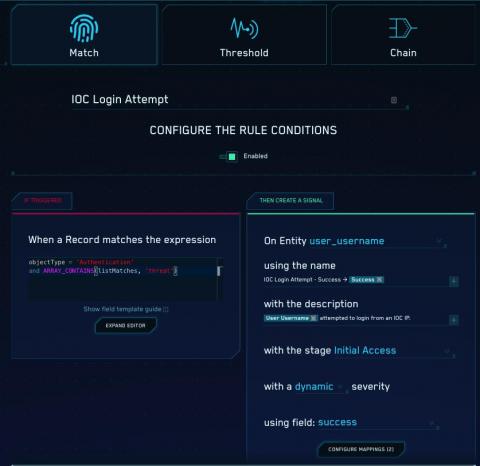
Detection engineering at Elastic is both a set of reliable principles — or methodologies — and a collection of effective tools. In this series, we’ll share some of the foundational concepts that we’ve discovered over time to deliver resilient detection logic. In this blog post, we will share a concept we call stateful detection and explain why it's important for detection.
Logging is probably not the first item to come to mind when most of us think about DevSecOps, a term that refers to the integration of security into DevOps processes, but it should be. Logging and log management play a critical role in helping to put DevSecOps principles into practice by ensuring that developers, IT operations staff, and security teams have the visibility and communication pipelines they need to prioritize security at all stages of the DevOps delivery cycle.
In an evolving world, the modernization of the security operations center (SOC) is pivotal to the success of digital transformation initiatives. Security teams, however, are facing a shortage of cybersecurity professionals and struggling to detect and prioritize high-priority threats. Analysts in data-driven organizations can combat these issues by bringing people, process and technology together.
The number of cyberattacks launched on organizations continues to rise every year. More attacks means more security alerts that security analysts have to triage each day. Many security teams have turned to a security orchestration, automation and response (SOAR) tool to help them automate the ever-increasing volume of security alerts, and respond to threats faster and more comprehensively.