Operations | Monitoring | ITSM | DevOps | Cloud

Lightrun Releases KoolKits - Debugging Toolkits for Kubernetes

KoolKits (Kubernetes toolkits) are highly-opinionated, language-specific, batteries-included debug container images for Kubernetes. In practice, they’re what you would’ve installed on your production pods if you were stuck during a tough debug session in an unfamiliar shell. To briefly give some background, note that these container images are intended for use with the new kubectl debug feature, which spins up Ephemeral containers for interactive troubleshooting.
Sponsored Post

How MSPs can benefit from AIOps adoption/strategy and add value-added services

According to Gartner, enterprise usage of AIOps is set to surge from a mere 5% in 2018 to a whopping 30% in 2023. To survive in an increasingly competitive market, MSPs must not only respond well to customer expectations but anticipate them. Another Gartner report states that by 2025, over 80% of public cloud managed and professional services deals will require both hybrid and multi-cloud capabilities from the provider, up from below 50% in 2020.

5 techniques for project management in IT and beyond

Project management is a growing field, it helps teams to organize and keep track of work, so projects can be executed successfully. It includes initiating, planning, executing, controlling/monitoring, and closing the project. So, the question is, is there one specific approach that we can use for effective project management? Definitely, not! Each project is unique and it would be impossible to employ a one-size-fits-all approach.

6 Important Questions About Asset Tags and Labels?

Organizations are equipped with a lot of assets and sometimes it becomes so hard to know where assets are located. To manage assets effectively, organizations must use asset labeling. Therefore, in this blog, we will know what exactly Asset labeling is. What are the benefits of Asset labeling? And several other questions and answers as well. It will help you to make the most of your assets. So, without wasting any time, let us begin.

How certificates work in Puppet

This video gives you a basic introduction to certificates and explains how they’re used to secure Puppet communications. Certificates help to provide secure connections between different parts of your infrastructure as those parts communicate with each other. When you run the agent for the first time, it submits a CSR (Certificate Signing Request) to the primary server. Then the CSR is reviewed by the Puppet administrator and either accepted or denied.

KoolKits - Highly-opinionated, batteries-included Kubernetes debugging toolkits

KoolKits (Kubernetes toolkits) are language-specific container images that contain a (highly-opinionated) set of tools for debugging applications running in Kubernetes pods. You can read more about the motivation behind this project here. Those images are intended for use with the new kubectl debug feature, which spins up Ephemeral containers for interactive troubleshooting. A KoolKit will be pulled by kubectl debug, spun up as a container in your pod, and have the ability to access the same process namespace as your original container.

Quickly troubleshoot application errors with Error Reporting

Are you familiar with the four golden signals of Site Reliability Engineering (SRE): latency, traffic, errors, and saturation? Whether you’re a developer or an operator, you’ve likely been responsible for collecting, storing, or analyzing the data associated with these concepts. Much of this data is captured in application and infrastructure logs, which provide a rich history of what is happening behind the scenes in your workloads.

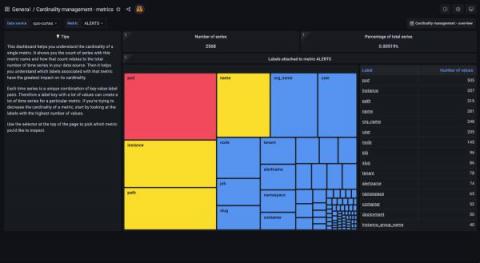
How to manage cardinality with out-of-the-box dashboards in Grafana Cloud

When there’s a cardinality explosion, it can cause problems: It’s a surprise, it’s noise, and it can increase your costs or cause performance degradation of your systems. Over the past year, we’ve improved our time series storage systems so that under normal use, high cardinality is no longer an issue. But as the operator of an observability platform, you should have tools you need to help protect that infrastructure.