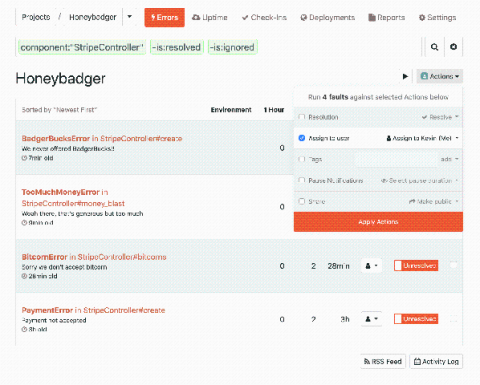
Honeybadger Actions
Have you ever wanted to update all your errors at once, or set defaults for incoming errors? Well, we are releasing some helpful tools for error management that we call Honeybadger Actions.


Have you ever wanted to update all your errors at once, or set defaults for incoming errors? Well, we are releasing some helpful tools for error management that we call Honeybadger Actions.
At LogicMonitor, we are continuously improving our platform with regards to performance and scalability. One of the key features of the LogicMonitor platform is the capability of post-processing the data returned by monitored systems using data not available in the raw output, i.e. complex datapoints. As complex datapoints are computed by LogicMonitor itself after raw data collection, it is one of the most computationally intensive parts of LogicMonitor’s metrics processing pipeline.
Many enterprises have already adopted Kubernetes or have a Kubernetes migration plan in place, making it clear that the platform is here to stay. While it provides a lot of benefits to its users, to take advantage of them, you need to thoroughly learn Kubernetes and how it works in production. Typically, the most difficult aspects of Kubernetes are learned through experience solving real-world problems.
Velocity, much like the pulse rate or oxygen level of an individual, is an important measure of health for your development team. A low velocity score for recent sprints limits your team's options for delivering value. Sustained failure to deliver to stakeholders can erode trust with those stakeholders quickly. But how do you know exactly what your velocity is and how you can improve it?
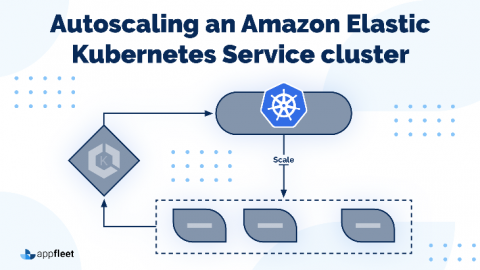
In this article we are going to consider the two most common methods for Autoscaling in EKS cluster: The Horizontal Pod Autoscaler or HPA is a Kubernetes component that automatically scales your service based on metrics such as CPU utilization or others, as defined through the Kubernetes metric server. The HPA scales the pods in either a deployment or replica set, and is implemented as a Kubernetes API resource and a controller.
In this post, we will cover some of the main use cases Filebeat supports and we will examine various Filebeat configuration use cases. Filebeat, an Elastic Beat that’s based on the libbeat framework from Elastic, is a lightweight shipper for forwarding and centralizing log data. Installed as an agent on your servers, Filebeat monitors the log files or locations that you specify, collects log events, and forwards them either to Elasticsearch for indexing or to Logstash for further processing.
This article will focus on using fluentd and ElasticSearch (ES) to log for Kubernetes (k8s). This article contains useful information about microservices architecture, containers, and logging. Additionally, we have shared code and concise explanations on how to implement it, so that you can use it when you start logging in your own apps. Useful Terminology.
Lately we’ve been working on improving different parts of the Mattermost server, including our monitoring and observability capabilities. We’ve been using Prometheus and Grafana to monitor our cluster for a while now, and you can read this great post where my colleague Stylianos explains how we have them working for our multi-cluster environment.