Operations | Monitoring | ITSM | DevOps | Cloud

SaaS Bootstrap Mailbox: "How did you start your product market fit?"

Something different this week. I got an email from an aspiring SaaS bootstrapper. Let's call him John. John explained his working situation at a tech startup and his dream to start a SaaS in the cloud security space by himself. He also had some pretty good questions. I asked John if it was OK if I answered them in the form of a blog post. He agreed, so here we are.

So You Want To Give A Tech Talk?

So you’ve signed up to give a tech talk, awesome! You’re a subject matter expert in something and want to share you knowledge, that’s what helps make a community awesome. You’re going to be speaking in front of a room of people that you don’t know in a place you’ve likely never been, talking about something you confidently know. Sounds easy, right?

Industry Analysts Recognizing Cloud Analytics Brings Wave of Disruption to the SIEM Market

In the new report, “Analytics is making its security operations mark ahead of schedule,” analyst firm 451 Research details the accelerating transition happening in the security information and event management (SIEM) space. The report underscores how new cloud-native analytics solutions are displacing traditional SIEMs at the heart of the defense.

Running Lambdas on your Laptop

Serverless has the potential to bring massive ops advantages to projects of all sizes, but while it presents great business benefits, we need to spare a thought for how teams develop on serverless. I recently published ‘Serverless Development is Broken’ a list of concerns about how developers can work with long deploy times inherent in a cloud-only code environment.

S3 Security: How to Easily Secure and Audit AWS S3 Buckets?

Amazon S3 is an object storage service widely used for storing many different types of data in the cloud. While it’s inexpensive and easy to set up and maintain S3 buckets, it’s also very easy to overlook S3 security aspects and expose them to malicious attacks. A typical example is accidentally allowing public access to S3 files. Several recent high-profile data breaches were caused by lax S3 security.

Kubernetes as a Service: GKE vs. AKS vs. EKS

Kubernetes (K8s) is a prevalent open-source system for automating the deployment, scaling, and management of containerized applications. However, maintaining the service can be difficult and expensive. For that reason, it is easy to find platforms offering Kubernetes as a managed service. In this article, we will analyze three of the most popular services currently available: Google Kubernetes Engine, Azure Kubernetes Service, and Amazon Elastic Container Service for Kubernetes.

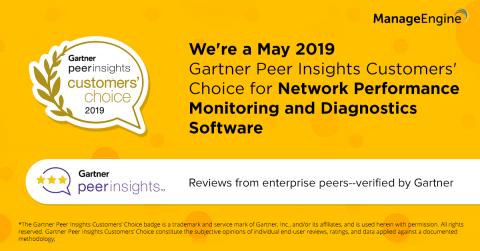
ManageEngine recognized as a May 2019 Gartner Peer Insights Customers' Choice for Network Performance Monitoring and Diagnostics Software

2019 continues to be a great year for ManageEngine accolades. This time, we are proud to announce that we’ve been named a May 2019 Gartner Peer Insights Customers’ Choice for Network Performance Monitoring and Diagnostics Software. The consistent performance of our network performance monitoring (NPM) solutions—OpManager, NetFlow Analyzer, and Network Configuration Manager—has been the driving force behind this recognition.

Stop Focusing on Time to First Byte and Do This Instead

Metrics are the lifeblood of every data-driven decision. Question after question on forums like Reddit, Stack Overflow and other IT communities ask which metrics teams should focus on for improving website speed and end-user experience. There’s a push in web development circles to focus on Time to First Byte (TTFB) to measure and improve website speed. But every viewpoint has its opposition.

Containerized Air Gapped Edge Platform Architecture

An emerging use case for containerized platforms has been the ability to deploy applications in what is termed as an air-gapped deployment. This deployment pattern is particularly pronounced around edge computing (more on that later in the blog series) – though there exist significant differences between edge clusters and air-gapped deployments. Air-gapped applications are those that run isolated from datacenter or internet connectivity.