Operations | Monitoring | ITSM | DevOps | Cloud

How to Setup Azure Files

Azure Files is a fully managed cloud-based file share service provided by Microsoft Azure. It allows users to store and share files in the cloud, with support for the Server Message Block (SMB) protocol, which is commonly used by Windows file shares. Azure Files provides a number of advantages for users, including: Azure Files is often used by organizations that need to share files across multiple locations or teams, or that need to provide secure access to files for remote or mobile workers.


OpenTelemetry on AWS, beyond instrumentation and into resource attributes

Instrumenting your code is essential to understanding your system’s performance and diagnosing issues as they arise. Traditionally, this was accomplished using proprietary vendor libraries, causing major lock-in. Enter OpenTelemetry. OpenTelemetry is an open-source project that provides a set of APIs, SDKs, and integrations for instrumenting code.

How Did Slack Perform a Year After the Acquisition by Salesforce

Slack is a popular messaging and communication platform used for work, study, groups, and communities. According to Techjury, more than 10 million people used Slack every day in 2022, and 43% of Fortune 100 businesses are paying for Slack subscriptions. On July 21, 2021, Salesforce completed its purchase of Slack for $27.7 billion and announced plans to make Slack an operating unit under Salesforce.

Qovery Demo Day - February 2023

Qovery is a platform delivering Environments as a Service in your Cloud, where you can build, deploy and test in production-like environments. Qovery turns app deployment and environment provisioning on AWS a breeze. Developers can instantly spin up production-like environments and start shipping in seconds. Join Albane (Product Marketing at Qovery), Alessandro (Lead Product Manager at Qovery), and Romaric (CEO at Qovery) to see in action what we worked on last month and what's next.

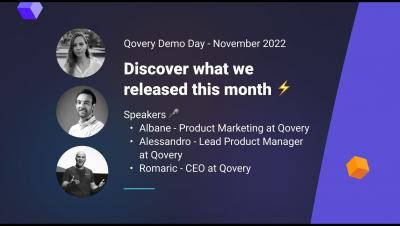
Qovery Demo Day - November 2022

Qovery is a platform delivering Environments as a Service in your Cloud, where you can build, deploy and test in production-like environments. Qovery turns app deployment and environment provisioning on AWS a breeze. Developers can instantly spin up production-like environments and start shipping in seconds. Join Albane (Product Marketing at Qovery), Alessandro (Lead Product Manager at Qovery), and Romaric (CEO at Qovery) to see in action what we worked on last month and what's next.

Qovery Demo Day - December 2022

Qovery is a platform delivering Environments as a Service in your Cloud, where you can build, deploy and test in production-like environments. Qovery turns app deployment and environment provisioning on AWS a breeze. Developers can instantly spin up production-like environments and start shipping in seconds. Join Albane (Product Marketing at Qovery) and all the Qovery team for a special end of the year Demo Day!

Google Drive vs. Google Cloud Storage: What's the Difference?

Google Drive and Google Cloud Storage are both cloud storage solutions, though they differ in purpose. Google created them to provide individuals or businesses with the exact capabilities and features to encourage collaboration and allow users to access their files from anywhere. Want to know which one is more suitable for your business? Keep reading to discover their differences and similarities!

Gopaddle - A Low-Code Internal Developer Platform for Canonical's MicroK8s edge cloud

We are excited to announce the launch of gopaddle, the Low-Code Internal Developer Platform, as a community addon for MicroK8s edge cloud. This addon will help Kubernetes developers accelerate the development of distributed applications at the edge. In today’s fast-paced business landscape, the ability to quickly and efficiently develop new applications is critical to success.

Beyond hybrid and remote: How MDM can support the rise of near-from-home working

Challenges & Solutions Now that the world is reopening again from the pandemic, many employees are reluctant to go back to the office, preferring the convenience of work-from-home. To retain these employees, many organizations are adopting a compromise: hybrid work. In this setup, employees go to the office a few days a week, then report virtually from home for the rest.