Operations | Monitoring | ITSM | DevOps | Cloud

The latest News and Information on Cloud monitoring, security and related technologies.

Cloud Savings: 10 Strategies To Save In The Cloud

A common misconception around cloud computing is that it’s automatically cheaper than running on-premises infrastructure. Unfortunately, when businesses switch to (or consider switching to) the cloud, their cloud savings may not be immediately evident. In fact, some businesses accrue more monthly costs with the on-demand cloud model than they would with on-premise systems. This begs the question: Is cloud computing really cost-effective?

Adding config to AWS ECS tasks

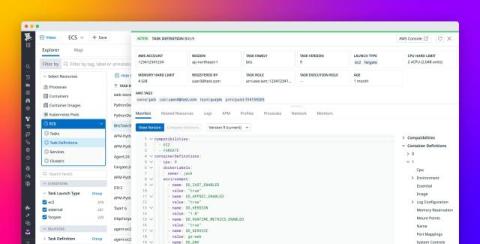
When deploying Docker containers to AWS ECS, you can encounter a situation where you want to run an image that requires some configuration. For example, let's say you wanted to run Vector1 as a sidecar to your main application so you can ship your application's metrics to a service like Honeybadger Insights. To run Vector, you only need to provide one configuration file (/etc/vector/vector.yaml) to the image available on Docker Hub.

INTEGRATE 2024 Day 2 Highlights

Dan Toomey, Senior Integration Architect at Deloitte Australia, kicked off the session by highlighting the essential role of business rules in software development. He emphasized the significance of managing evolving and complex business rules, advocating for the use of effective tools like Business Rules Management Systems (BRMS) to safeguard code and services.

8 questions for cloud cost optimization-Part 1

Our perception of the cloud is underpinned by three terms: scalable, flexible, and efficient. These adjectives, however, are only the capabilities of the cloud—not the benefits. Turning the cloud’s capabilities into benefits involves understanding the nature of the cloud and optimizing how you use it based on that. From choosing your cloud vendor to rewriting your code for the cloud, our cloud cost efficiency checklist spans a wide spectrum of planning and actions.

VPNs and Cloud Storage: Protecting Data Integrity and Privacy

In an era where data breaches and cyber threats have become all too common, ensuring the integrity and privacy of data has never been more critical. Two powerful tools in this ongoing battle are Virtual Private Networks (VPNs) and cloud storage services. Together, they provide a robust defense mechanism for both individuals and businesses, securing sensitive information from prying eyes and unauthorized access.

The Ultimate Cloud Security Checklist: How to Protect Your Brand's Data

The cloud revolution is here. The flexibility, scalability, and cost savings of cloud computing have led businesses of all sizes to migrate operations to the cloud. By 2025, Gartner estimates that over 95% of new digital workloads will be deployed on cloud-native platforms. But this monumental shift is not without risks. High-profile data breaches like the Capital One hack serve as sobering reminders that the cloud introduces new attack surfaces and vulnerabilities.

The Role Of Finance Teams In Cloud Cost Management

As businesses increasingly migrate to cloud-based solutions to enhance their operational flexibility, the challenge of managing cloud expenses has become more pronounced. This development has highlighted the crucial role of finance teams, who are now integral in overseeing these complex cost structures.

INTEGRATE 2024 Day 1 Highlights

Slovo Koltovich, Principal GPM at Microsoft, delivered the keynote at Integrate 2024. He began by discussing Azure Integration Services (AIS), a comprehensive platform enabling the creation of tailored solutions to meet unique requirements. The primary advantage of AIS lies in its focus on security and compliance. With nearly 800 connectors, AIS facilitates connections to numerous data sources. Microsoft invests billions annually in security, with thousands of personnel dedicated to it.

Is investing in AI-driven cloud services worth the expense?

Artificial intelligence (AI) is the next significant technological frontier, poised to revolutionize the tech sector, particularly through its massive impact on cloud infrastructures. By 2024, this transformation is expected to be as widespread as managed Kubernetes services, with an estimated 70% of organizations utilizing managed AI services in their cloud setups.