How Atlassian teams use Bitbucket Cloud
Learn how senior developers at Atlassian use Bitbucket Cloud to do code review and automate deployments in an enterprise environment.


The latest News and Information on DevOps, CI/CD, Automation and related technologies.
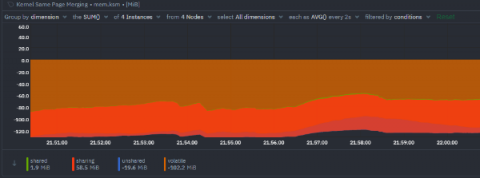
Monitoring KSM (Kernel Same-page Merging) performance at deduping memory shared across VMs.
The events over the past two and a half years have radically changed the world. Digital transformation initiatives went from being a priority to an urgent imperative. Enterprises that had not already migrated data to the cloud rushed to do so during the pandemic, and others accelerated their on-premise-to-cloud shifts. Hybrid and multi-cloud environments become the new reality for many organizations who want to get the most out of their on-premises and cloud investments.
Are you interested in learning how to monitor Nginx? In this post, we'll show you all about how Nginx works and how you can use Hosted Graphite to monitor it. First, we'll read what Nginx monitoring is all about and how it can together work with Prometheus. Nginx, pronounced like “engine-ex”, is an open-source web server that, since its initial success as a web server, is now also used as a reverse proxy, HTTP cache, and load balancer.
Businesses need a new, more flexible solution to make digital transformation far easier, says Daniel Blackwell, Product Manager – Networks & Security, Pulsant Digital transformation can provide businesses with a more flexible approach to infrastructure that simplifies the delivery of services and applications. However, this journey to digital transformation can introduce its own complexities that require a new way of thinking.
Application monitoring plays a critical role in the success of your digital products. As you monitor various performance metrics such as usage of CPU, memory, network traffic, and more, you can swiftly take pre-emptive actions before things develop into a larger problem. In spite of the importance of monitoring, the task can become challenging when your infrastructure exists across multiple cloud platforms including AWS and Heroku.
This is the third blog from a series focusing on how public clouds meet telecommunication operators’ business demands. In the previous two blogs, we talked about how Amazon Web Services (AWS) and Google Cloud Platform have enabled telcos to run critical workloads on public clouds. In this last part of our series, you’ll hear about Microsoft Azure cloud and why it’s a trusted platform for the telecommunication industry to host their workloads.
Welcome to the November 2022 edition of Open Source Matters where we cover the latest news in open source technology. I’m your host, Ben Lloyd Pearson, let’s dive in.
OpsRamp’s Operating System Patch Management module is a flexible, yet powerful capability provided to all OpsRamp platform customers or licensed separately. With our SaaS-based OS Patching solution for Windows and Linux endpoints, you can automate the entire patch management process from identification of missing OS patches to the process of patch installation.