The FDNY EMS Command responds to more than 4,000 calls per day. They range from car accidents to building fires to cats stuck in trees, and responses vary accordingly. Sometimes they might take hours, sometimes they take just a few minutes. With such unpredictable conditions, the FDNY focuses on improving what they call “response time.” That’s the amount of time between a 911 call being made and emergency responders arriving on the scene. This might sound familiar.
The mem.kernel chart in Netdata provides insight into the memory usage of various kernel subsystems and mechanisms. By understanding these dimensions and their technical details, you can monitor your system's kernel memory usage and identify potential issues or inefficiencies. Monitoring these dimensions can help you ensure that your system is running efficiently and provide valuable insights into the performance of your kernel and memory subsystem.
Netdata provides a comprehensive set of charts that can help you understand the workload, performance, utilization, saturation, latency, responsiveness, and maintenance activities of your disks. In this blog we will focus on monitoring disks as block devices, not as filesystems or mount points. The Disks section in the Overview tab contains all the charts that are mentioned in this blog post.
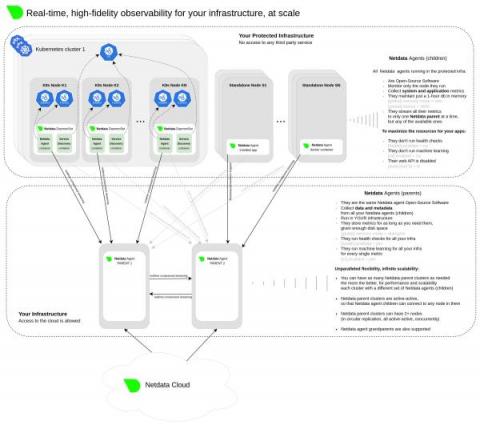
Scalability is crucial for monitoring systems as it ensures that they can accommodate growth, maintain performance, provide flexibility, optimize costs, enhance fault tolerance, and support informed decision-making, all of which are critical for effective infrastructure management.
If you're accustomed to running software in production, you know that every minute counts when there's a disruption. However, not every issue is obvious enough to immediately find and remediate. That can be a big obstacle to overcome, which is where StackState's Kubernetes remediation guides come into play. They contain expert knowledge that guides you step by step to understand the issue, enabling swift remediation.
Cloud computing revolutionized how a business can establish its digital presence. Nowadays, by leveraging cloud features such as scalability, elasticity, and convenience, businesses can deploy, grow, or test an environment in every corner of the world without worrying about building the required infrastructure.
It may feel like ancient history, but it was only a few years ago that, in response to the pandemic, organizations made a wholesale shift to support hybrid work models—and did so literally overnight, in many cases. While some time has passed, this is a shift to which many IT organizations are still struggling to fully adapt.
There are numerous instances where a single buildpack falls short in app building, for instance when working on a NodeJS app with a PHP backend. We are thrilled to announce the global and immediate availability of Multi-Buildpacks for all app sizes, including our Free tier. The Multi-Buildpack feature allows you to: Alongside the introduction of multi-buildpacks, we're expanding support for Add-on buildpacks (such as APT, Static, or the newly introduced FFmpeg buildpacks).