Operations | Monitoring | ITSM | DevOps | Cloud

The latest News and Information on Monitoring for Websites, Applications, APIs, Infrastructure, and other technologies.

DNS Spy Now Connects to Amazon Route 53. Read-Only, Every Record, Always in Sync.

When we launched DNS provider sync with six providers, one name came up in nearly every "what about..." email: Amazon Route 53. That makes sense. Route 53 runs DNS for an enormous share of production infrastructure, and it does not support zone transfers — so until now, monitoring a Route 53 zone meant relying on autodiscovery's educated guesses. Today that gap closes.

From Visibility to Prediction: How AI-Driven Operations Build Trust at Scale

Visibility was once the finish line. Centralized monitoring and correlated logs represented meaningful progress. But hybrid cloud environments continued to expand in scale and complexity. Visibility alone no longer guarantees clarity. Across eleven operator interviews, the recurring challenge was not data scarcity. It was interpretation. Telemetry volumes were abundant. Correlation required manual effort. Alert floods introduced friction. Systems were visible, but the path to decisive action was unclear.

Catch Next.js Hydration Errors With Playwright Tests

Playwright can catch Next.js hydration errors by listening for browser console failures and then exercising an interaction that only works after React has attached its event handlers. This detects pages that return 200 OK and display server-rendered content but fail when a customer clicks, types, or navigates. Next.js defines hydration as React attaching event handlers to the server-rendered HTML.

MCP for SLA Monitoring: Uptime, MTTR & MTTA

MCP for SLA monitoring gives an AI agent direct access to measured uptime, mean time to resolve (MTTR), mean time to acknowledge (MTTA), outages, and reliability risks. With Hyperping, you can ask Claude, Cursor, Codex, or another MCP client for an SLA report and get an answer based on your live monitoring data instead of copying numbers between dashboards. The distinction between monitoring data and SLA compliance matters. Hyperping measures availability and incident response.

Security Observability: Pillars, Use Cases, and How It Works

When an alert lands, does your team already see the full story, or does the work start with pulling scattered data together from one tool after another? For many organizations it's the second one, where the incident itself takes a backseat while analysts hunt across dashboards. The evidence is right there, scattered across platforms that don't share context. Security observability exists to close that gap.

ActiveMQ Performance Benchmarks: A Complete Methodology Guide

Most ActiveMQ performance benchmarks are wrong, not slightly off, but fundamentally invalid for capacity planning. Performance benchmarking done incorrectly is worse than not benchmarking at all. A number that looks like a throughput measurement but was collected without JVM warmup, without latency percentiles, with the load generator co-located on the broker host, and while producer.

Better Together: Last9 + Altinity

Last9 and Altinity now run observability entirely in your own cloud, metrics, logs, traces, and profiles on an open-source ClickHouse stack, priced on capacity instead of ingestion, with Altinity operating the database so your team doesn't have to. Last9 is an observability platform built for high-cardinality telemetry. It unifies logs, metrics, and traces with native OpenTelemetry and Prometheus support, real-time alerting, and long-term retention.

Inside LeoLabs: How Radar Engineers Track Over 27,000 Objects in Orbit with InfluxDB

Summary InfluxDB plays a critical role in LeoLabs’ infrastructure, enabling a lean team to operate with confidence that potential issues will be detected and surfaced in real-time. By offloading the complexity of managing time series data at scale, engineers are free to focus on higher-impact work (such as optimizing their radar network) rather than maintaining and troubleshooting database systems.

How to structure a log

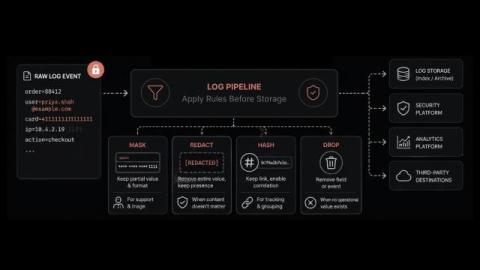
You’ve decided to step up your logging game and start sending more valuable, structured logs that you can query, aggregate, and use for debugging in production. Go, you! Now, uh, how do you actually write them? We’re not going to spend much time on what you should log. We’ve covered that already, a few times before. What we will be covering is how to actually write those logs, answering questions like: What makes a log structured is not just pairing messages with arbitrary JSON objects.