Operations | Monitoring | ITSM | DevOps | Cloud

The latest News and Information on Serverless Monitoring, Management, Development and related cloud technologies.

How I Manage Credentials in Python Using AWS Secrets Manager

A platform-agnostic way of accessing credentials in Python. Even though AWS enables fine-grained access control via IAM roles, sometimes in our scripts we need to use credentials to external resources, not related to AWS, such as API keys, database credentials, or passwords of any kind. There are a myriad of ways of handling such sensitive data. In this article, I’ll show you an incredibly simple and effective way to manage that using AWS and Python.

7 Reasons Why Serverless Encourages Useful Engineering Practices

Serverless provides benefits far beyond the ease of management…it strongly encourages “useful” engineering practices. Here’s how. It’s hard to determine what can be considered a “good” or “bad” engineering practice. We often hear about best practices, but everything really boils down to a specific use case. Therefore, I deliberately chose the word “useful” rather than “good” in the title.

How to monitor AWS SQS with Prometheus

In this article, we will explain how to monitor AWS SQS with Prometheus. To monitor AWS SQS, we will leverage the data offered by CloudWatch exporting the metrics to Prometheus using the YACE exporter (Yet Another CloudWatch Exporter). Finally, we will dive into what to monitor and what to alert. AWS SQS (Simple Queue Service) has gained popularity as a way to communicate and decouple asynchronous applications, specifically for its easy integration with AWS Lambda functions.

3 ways of recycling third-party code for AWS Lambda

In this article, I’m trying to shine some light on the AWS Lambda Layers, Lambda Extensions, and Docker image for Lambda, in order to add third-party code to Lambda. When and how to use which method, and when to mix and match? Due to the circumstances in 2020, many software releases were postponed, and so the industry slowed its development speed quite a bit. But at least at AWS, some teams got updates out of the door at the end of the year. AWS Lambda got two significant improvements.

Automatically debug and test CI/CD Pipeline with Dashbird

In this article, we will build a CI/CD pipeline with the AWS Cloud Development Kit (CDK) and debug a test it using Dashbird’s observability tool. In 2021, continuous integration and continuous delivery, or short CI/CD, should be part of every modern software development process. It helps deliver new features and bug fixes much faster.

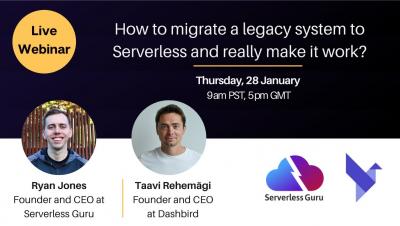
Serverless at Scale: How to migrate a legacy system to Serverless and make it work?

Thinking about moving your business to Serverless in 2021 and really making it work for you? This webinar is for you!  In the first part of the session we’ll be covering all the important and often overlooked of steps and best practices of moving to serverless. Starting from how do you actually go about migrating a legacy system, all the way to how to empower your team through the transition and level up their skills thereafter. 

So, you want to monitor your serverless applications...

If you’re already using or planning to use AWS Lambda to run code without provisioning or managing servers, you’ll want to monitor your serverless applications with the new SolarWinds® AppOptics™ Lambda forwarder and APM agents. If you’re not using AWS Lambda, here’s what you need to know—it’s an event-driven, serverless computing platform by Amazon Web Services.

What to bear in mind before migrating to Serverless?

Serverless has been gaining more and more traction over the last few years. The global serverless architecture market was estimated at $3.01 billion in 2017 and is expected to hit $21.99 billion by 2025. The number is reflected in the increasing amount of enterprises starting to look for ways of decoupling their current monolithic architectures and migrating their stack to serverless. Read more about the popular enterprise use cases for AWS Lambda.

Webinar: Why your next serverless project should use AWS AppSync

GraphQL APIs offer a number of advantages over REST APIs, such as solving the “N+1 requests” problem. And AppSync makes building scalable and performant GraphQL APIs much easier because it takes care of all the infrastructure concerns for you. In this webinar, AWS Serverless Hero Yan Cui and Lumigo Software Engineer Guy Moses discuss some of the power of GraphQL and AppSync and why AppSync + Lambda + DynamoDB should be your stack of choice.