As product managers, you’re ultimately the one held responsible for the entire product. So the last thing you want to assume is that someone else has got monitoring and alerts covered. In the first days of a release, all eyes are on the new product or latest feature. Just a few months later, when you introduce a brand new feature, the old one might break in the process. At times like these, you want to be ahead of your users, and not hear from your users that something isn’t working.
First and foremost, we are human. We can’t get around it, and some things will make us anxious, frustrated, and mad. As much as we like to think we are optimists, we frequently don’t notice something until it disappoints us in some way. In this article, we will take a look at how web performance and psychology impact user satisfaction.
In A Comedy of Errors, we talk to engineers about the weirdest, worst, and most interesting application and infrastructure issues they’ve encountered (and resolved) over the years. This week, we hear from Or Weis, co-founder and CEO of Rookout. Rookout’s focus is on collecting data in a seamless, immediate way that maximizes a developer’s insight into live code.
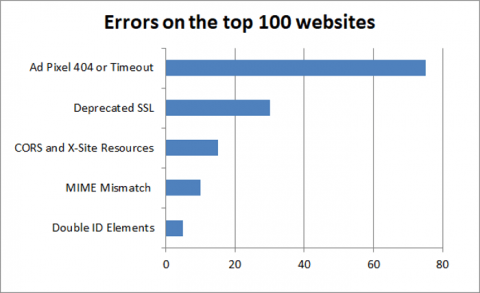
When you think of the top 100 sites in the world, you think of high-traffic domains and pages coded to perfection. In fact, even the most popular sites in the world have errors hidden behind the scenes that are still visible in your browser’s developer tools. These can affect your experience as a user directly, create inaccurate tracking data and security vulnerabilities, and even lose the company revenue.
Why could a spike itself not always be good news? Why is it so important to find the relationships between time series metrics at scale?
For any company with an online presence, website traffic is important. The more visitors you attract, the more opportunities you’ll have to advertise your brand, establish relationships and ultimately sell your service or product. This is why a sudden drop in search engine traffic is a frightening prospect, since it ultimately leads to business losses and lower revenue.
We surveyed 1,264 chat users to find out, and we started with two seemingly simple questions. What we learned was fascinating and inspiring, so we gathered up the data and created the team chat guide.
With the proliferation of virtualization and high availability architecture, teams are chasing 99.999% uptime like knights of old hunted unicorns. Many site reliability engineers find more comfort in the Boy Scouts’ motto, “Always be prepared.” Your company’s Git server is mission critical to the daily operations of engineering and everyone they support. How do you create business continuity in the face of unpredictable circumstances?
This article explores integrating Google Pub/Sub with the world’s most popular open source log analysis platform — the ELK Stack, for deeper analysis and investigation.