Operations | Monitoring | ITSM | DevOps | Cloud

Agent vs Agentless Monitoring: Which is Best?

Agent-based and agentless monitoring are the two main approaches network monitoring tools use to capture and report data from network devices. As the names suggest, the difference between the two is pretty simple: someone has to install extra software(the agent) for agent-based monitoring to work. But, that doesn’t explain why an IT team or an MSP would choose agent-based or agentless monitoring.

How to gain Kubernetes visibility in a few clicks

Enterprises are increasingly adopting Kubernetes for the value that it brings to their organizations, from IT cost savings to improved time to market for application development. See how Sumo Logic can help you realize the value of Kubernetes faster with a guided onboarding setup that only requires a few clicks to go from zero to visibility.

Tracing vs. Logging: What You Need To Know

Log tracking, trace log, or logging traces… Although these three terms are easy to interchange (the wordplay certainly doesn’t help!), compare tracing vs. logging, and you’ll find they are quite distinct. Logs, traces, and metrics are the three pillars of observability, and they all work together to measure application performance effectively. Let’s first understand what logging is.

Best Practice Series: Securing the Monitoring System

Network security makes the headlines at least once per day – and usually for the wrong reasons. In today's world, ensuring and maintaining a secure deployment is of utmost importance. Did you know that WhatsUp Gold provides several important security features that you can configure and manage to maintain a secure deployment? These features can help you to defend against unauthorized access to the WhatsUp Gold server as well as to devices monitored by WhatsUp Gold.

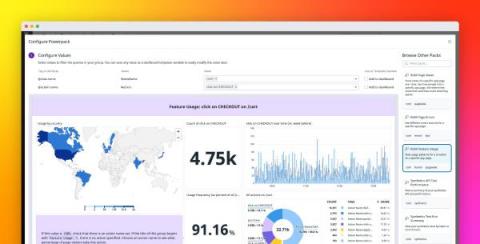
Save and share reusable dashboard widget groups with Powerpacks

Dashboards allow you to visualize and correlate monitoring data from across disparate data sources, technologies, and infrastructure components to understand what’s going on in your environment. In a growing organization, it’s paramount to standardize how teams build their dashboards to ensure their consistency and legibility.

How we improved Grafana Mimir query performance by up to 10x

Earlier this year we introduced the world to Grafana Mimir, a highly scalable open source time series database for Prometheus. One of Mimir’s guarantees is 100% compatibility with PromQL, which it achieves by reusing the Prometheus PromQL engine. However, the execution of a query in the Prometheus PromQL engine is only performed in a single thread, so no matter how many CPU cores you throw at it, it will only ever use one core to run a single query.