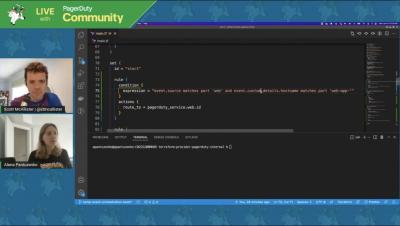
PagerDuty Event Orchestration in Terraform
Scott McAllister, Developer Advocate, PagerDuty Alena Pantuzenko, Software Engineer, PagerDuty


Kubernetes is an open source platform that, through a central API server, allows controllers to watch and adjust what’s going on. The server interacts with all the nodes to do basic tasks like start containers and pass along specific configuration items such as the URI to the persistent storage that the container requires. But Kubernetes can quickly get complicated. So, let’s look at Vanilla Kubernetes — the nickname for a a K8s setup that’s as basic and elementary as it gets.
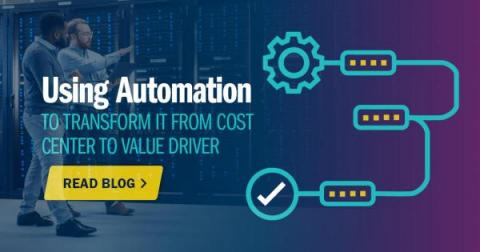
In today’s digital age, IT has become the central component of business operations. Yet, despite its critical importance, skilled technicians continue to find their hands tied by time-consuming manual tasks. And, while many of these tasks are essential, they do virtually nothing to drive innovation. Introducing automation into the mix can free up IT talent to focus their skills on more important business initiatives – particularly those that drive change and generate revenue.
If your organization is embracing cloud-native practices, then breaking systems into smaller components or services and moving those services to containers is an essential step in that journey. Containers allow you to take advantage of cloud-hosted distributed infrastructure, move and replicate services as required to ensure your application can meet demand, and take instances offline when they’re no longer needed to save costs.
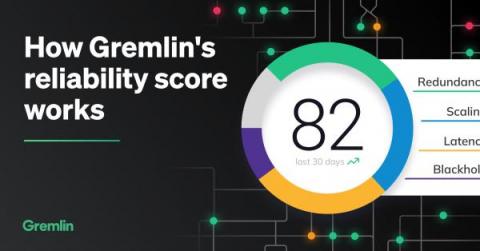
In order to make reliability improvements tangible, there needs to be a way to quantify and track the reliability of systems and services in a meaningful way. This "reliability score" should indicate at a glance how likely a service is to withstand real-world causes of failure without having to wait for an incident to happen first. Gremlin's upcoming feature allows you to do just that.
Arm processors have become increasingly popular in recent years, providing energy-efficient, cost-effective processing power to both mobile and cloud computing ecosystems. As a part of this growth, more and more organizations are choosing to leverage the many benefits of Arm-based architectures for their containerized workloads. Today, Google Cloud announced its Arm-based Tau T2A virtual machines (VMs), which you can also use to run workloads in Google Kubernetes Engine (GKE).
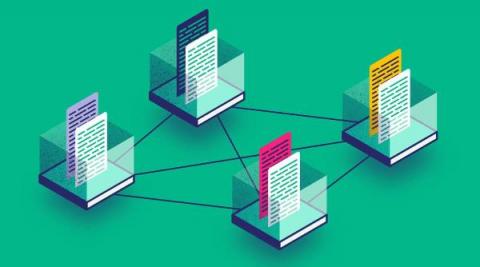
In distributed systems, middleware is a software component that provides services between two or more applications and can be used by them. Middleware can be thought of as an application that sits between two separate applications and provides service to both. In this article, we will see a role of middleware in distributed systems.
TL;DR: We’ve raised $34M to bring increased resilience to organisations around the world. With this latest round of investment we’re expanding internationally in the US, accelerating our product plans, and growing our amazing team 🎉 As technology becomes more complicated and runs an ever greater part of our lives, failure becomes more inevitable, and more costly.
OpenTelemetry (also known as OTel) is a popular open-source framework used to generate telemetry data for traces, metrics, events and logs. In this guide, we are going to cover the best observability and application performance management tools that can be used alongside OpenTelemetry to transform telemetry data into responsive reporting dashboards.