Operations | Monitoring | ITSM | DevOps | Cloud

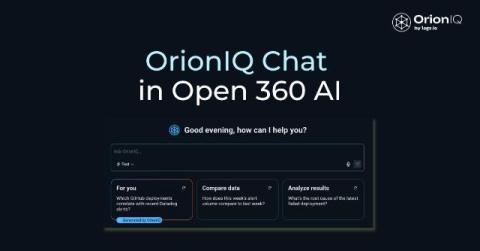
Open 360 AI's chat is now powered by OrionIQ

OrionIQ’s agentic investigation is now built into Logz.io Open 360 AI. Ask a question and OrionIQ investigates across your telemetry, shows its work as it goes, links every finding back to the exact query behind it, and tells you how much to trust the answer. Today we’re bringing OrionIQ Chat into Open 360 AI. This is the first OrionIQ product to ship inside the Logz.io platform, and it’s the same agent that powers the standalone OrionIQ app, now available right where you already work.

How to measure AI ROI: metrics and a framework finance can actually run

To measure AI ROI, compare attributable value (revenue lift, cost savings, engineering time recovered, risk reduction) against fully loaded AI spend (API usage, subscriptions, infrastructure, people time) at the unit level: per initiative, per team, per task. The formula is simple. The instrumentation is the hard part, and it's where most organizations are failing: in CloudZero's 2026 survey, 34% of finance leaders couldn't produce a credible ROI number at all.

Shipped: Catch a cost spike before it hits your bill

You’re probably already tracking the metrics that matter most in your Analytics dashboards like unit economics, AI ROI, and spend by team. Now you can put a target on any of them. Pick the metric, set the threshold, and CloudZero emails you when it’s crossed, with no ticket to us, no custom build.

Keyword Monitoring: Check Content, Not Just Uptime

Updated August 05, 2026 Keyword monitoring checks that a specific string is still present in a page or API response on every run, instead of trusting the HTTP status code. It catches the failures that uptime checks sleep through: a deploy that renders an empty template, a CMS entry someone unpublished, a checkout page serving "Something went wrong" with a perfectly healthy 200. In Hyperping, the simple version is a text body assertion on an HTTP monitor and takes about ten seconds to set up.

Getting started with Ansible playbooks in CFEngine

Recently, I’ve been playing around with the ansible promise type by Fabio Tranchitella. It’s amazing how easy it is to leverage the benefits of agents with all the existing automation from the ansible community. Hence, I wanted to share it in a blog post, with an emphasis on easy. Let’s start off by creating a new cfbs project in a cfengine-ansible directory. Make sure to answer yes on the prompt to build on top of the default policy set.

NVIDIA B300 vs. NVIDIA B200: Blackwell Ultra vs. Blackwell

The Blackwell architecture arrived in 2024 as NVIDIA's answer to the next era of AI compute. The B200 set a new standard for inference performance, memory capacity, and training throughput, and many teams are still ramping up their use of it today. Then came Blackwell Ultra. The B300 is built on the same silicon foundation as the B200: same dual-reticle die design, same TSMC 4NP process node, same NVLink 5 interconnect.

What Is Coherent Optics?

Coherent optics is an advanced optical transmission technology that uses the modulation of light amplitude and phase, combined with digital signal processing, to transmit massive amounts of data over existing fiber optic cables, dramatically increasing network capacity by maximizing spectral efficiency without requiring new physical fiber deployments. Next-generation transport networks face a constant challenge: scaling capacity to keep up with relentless data growth.

Integrating Icinga and Prometheus

Guest post by Markus Opolka, Senior Consultant at NETWAYS. Originally published on the NETWAYS blog as “Icinga und Prometheus integrieren” and “Alertmanager-Icinga-Bridge – Ein Signalilo Fork”, combined and adapted for the Icinga blog with permission. Icinga and Prometheus are both great monitoring solutions, however, their focus is different. In this article, we look at how to integrate both monitoring systems and utilize the strengths of both tools.

This Month in Datadog - July 2026

In July’s episode of This Month in Datadog, Ruxanda Lueck joins Jeremy for a conversation about how you can confidently evaluate and release features that contain AI-generated code. She also discusses her career trajectory from containers to AI, how agentic workflows impact trust during feature development, and the challenges of testing nondeterministic agent behavior.

From Claude Code to Production: A Monitoring Checklist for Python Developers

Python is the native language of AI-assisted development. Models are really good at writing it, and a lot of people are now shipping it without ever having written much Python themselves. The whole thing is really simple. You prompt an app, Claude Code or Cursor produces a working Flask or FastAPI backend, and you’re live in a few hours. However, there’s still a big difference between “it works on my machine” and “it works in production”.