Talking about competition can be hard. It’s understandable. Product positioning can be touchy subjects especially when those use cases overlap. In the DevOps space, event-driven architectures are certainly not a new concept. Companies like Netflix, LinkedIn, and Facebook have in-house tools built specifically for this type of automation. However, Relay’s mission is make it easy for everyone to build event-driven workflows – not the Netflix-es of the world.
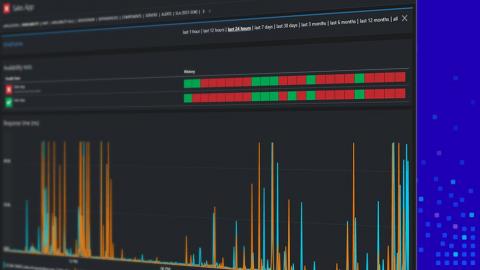
IT professionals are now adapting to a remote environment and learning to manage a distributed, homebound workforce. From a technical standpoint, the process of setting up a remote workforce is well-known. For this blog post let’s dive into one step of the process, which is arguably the most important, user experience monitoring.
Security Information Monitoring or Security Event Monitoring is part of Security Information Management. Yes, I acknowledge they are flashy names and that even experts have their differences about concept and scope. Here in Pandora FMS, flexibility is part of our name, so, hereby, I will abbreviate it as Security Monitoring. As you can see, it is short and manageable!
Here is an overview of the features & fixes we released over the last ~2 months.
Software development and delivery is an ever-changing landscape. Writing software was once an art form all its own, where you could write and deploy machine code with singleness of purpose and no concern for things like connecting to other computers. But as the world and the variety of systems that software supports became more complex, so did the ecosystem supporting software development.
In Part 1 of this blog series, we took a look at how we could use Elastic Stack machine learning to train a supervised classification model to detect malicious domains. In this second part, we will see how we can use the model we trained to enrich network data with classifications at ingest time. This will be useful for anyone who wants to detect potential DGA activity in their packetbeat data.