Operations | Monitoring | ITSM | DevOps | Cloud

The latest News and Information on Distributed Tracing and related technologies.

Debugging Microservices in Production with Distributed Tracing

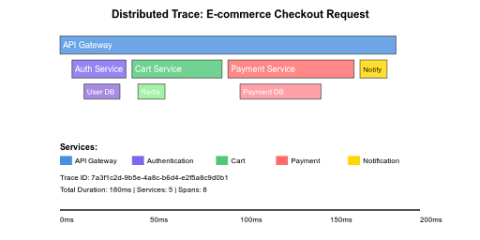
Your production checkout flow just started returning 500 errors. Six microservices handle checkout. Logs show errors in three of them. Which service broke? Which error happened first? What caused the cascade? Traditional debugging doesn't work. You can't attach a debugger to production. Searching logs across six services gives thousands of lines with no obvious connection. By the time you correlate timestamps and trace IDs manually, customers have abandoned their carts.

OpenMetrics vs OpenTelemetry - A guide on understanding these two specifications

OpenMetrics and OpenTelemetry are popular standards for instrumenting cloud-native applications. Both projects are part of the Cloud Native Computing Foundation (CNCF) and aim to simplify how we generate, collect and monitor services in a modern cloud-native distributed application environment. Let's have a look at how both the standards are aiming to help solve the observability conundrum.

Monitor Kubernetes Hosts with OpenTelemetry

It’s 3 AM. API latency just spiked from 200ms to 2s. Alerts are firing, and users are frustrated. You SSH into the first server: top, free -h, iostat — nothing unusual. On to the next host. And the next. That’s how most of us learned to debug. The tools worked, and we got good at using them. But as infrastructure became distributed and dynamic, this approach started to break down. Modern monitoring needs more than SSH and top. It needs unified telemetry.

Grafana Labs Co-founder Woods: Market maturity, OpenTelemetry, and AI are reshaping observability

As organizations navigate increasingly complex tech environments, unified observability practices have become essential. That was one of the main takeaways from Grafana Labs Co-founder Anthony Woods’ recent appearance on “Tech Keys by by Mercari India,” a podcast hosted by Vaibhav Khurana, Head of Platform Engineering at Mercari India.

LLM Observability in the Wild - Why OpenTelemetry should be the Standard

A few days ago I hosted a live conversation with Pranav, co-founder of Chatwoot, about issues his team was running into with LLM observability. The short version: building, debugging, and improving AI agents in production gets messy fast. There's multiple competing standards for default libraries for LLM observability. And many such libraries like OpenInference which claim to be based on OpenTelemetry don't strictly adhere to it's conventions.

An overview of Context Propagation in OpenTelemetry

To effectively manage modern applications, you need to understand how they work on the inside. Distributed tracing is the key to this, providing a detailed picture of a request's journey across every service. OpenTelemetry has emerged as the industry-standard framework for implementing tracing and achieving true observability in complex, distributed systems. In this article, we embark on a journey to explore the core concept of context propagation within Open Telemetry.

Monitor and optimize your systems with Uptrace

Uptrace is your single source of truth for monitoring, understanding, and optimizing complex distributed systems. Proven in production for over five years and trusted by more than a thousand installations worldwide, it lets you see your system like never before. What makes the difference is that Uptrace is pure OpenTelemetry, built natively from day one. This isn't a translation layer—it's a direct connection that eliminates friction and ensures zero vendor lock-in. Your homepage serves as your command center, providing complete visibility across your stack at a glance.

OpenTelemetry and Jaeger | Key Features & Differences [2025]

OpenTelemetry is a broader, vendor-neutral framework for generating and collecting telemetry data (logs, metrics, traces), offering flexible backend integration. Jaeger, on the other hand, is focused on distributed tracing in microservices. Earlier Jaeger had its own SDKs based on OpenTracing APIs for instrumenting applications, but now Jaeger recommends using OpenTelemetry instrumentation and SDKs. Warning The original Jaeger client SDKs (based on OpenTracing) are archived and no longer maintained.

Integrating JMX and OpenTelemetry

The OpenTelemetry community and the contributors to the Java Special Interest Group (SIG) have spent a great deal of time integrating core Java technologies into the project. An integration that is particularly useful is Java Management Extensions (JMX). It has been around since J2SE 5, and has been mature for some time. Many of the most widely used Java applications have adopted it over time and support this extension.

How to Connect Jaeger with Your APM

Microservices make it tough to understand how applications behave end-to-end. Most teams already rely on an Application Performance Monitoring (APM) tool to track system health. But as requests move across many services, you also need distributed tracing. Jaeger gives you that visibility. The real value comes from connecting the two. Instead of running APM and Jaeger in silos, you can combine their strengths, metrics from your APM, and traces from Jaeger, to get a clearer view of performance.