Operations | Monitoring | ITSM | DevOps | Cloud

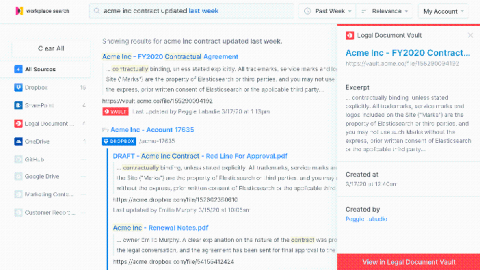
Getting started with Elastic Workplace Search on Elastic Cloud

Chances are you already spent a big part of your day looking for a document, an email, or an answer that lies deep within a Google Slides presentation. Thankfully, you landed in the right place. With Workplace Search, finding the right information across all your cloud and on-premises data platforms is now easier than ever, and it’s a few clicks closer than you expect.


Investigative analysis of disjointed data in Elasticsearch with the Siren Platform

At Siren, we build a platform used for “investigative intelligence” in Law Enforcement, Intelligence, and Financial Fraud. Investigative intelligence is a specialisation of data analytics that serves the needs of those that are typically hunting for bad actors. Such investigations are the primary focus of law enforcement and intelligence, but are also critical to uncovering financial crime activities and for threat hunting in cybersecurity.

Introducing the InfluxDB Template UI: Monitoring Made Simple

At InfluxData, we’re obsessed with time to awesome — how quickly can you start working productively with time series data? What can we do to make things better? InfluxDB Templates are a great example of this mindset. Back in April, we announced Templates as a way to package up everything you need to monitor a particular technology — Telegraf configurations and InfluxDB Dashboards, Tasks, Alerts, and related artifacts — into a single configuration file.

TL;DR InfluxDB Tech Tips - From Subqueries to Flux!

In this post we translate subqueries, using InfluxQL in InfluxDB version 1.x, into Flux, a data scripting and functional query language in InfluxDB version 1.8 and greater in either OSS or Cloud. The subqueries translated here come from this blog. This blog assumes that you have a basic understanding of Flux. If you’re entirely unfamiliar with Flux, I recommend that you check out the following documentation and blogs.

MLTK Smart Workflows

I’m excited to announce the launch of a new series of apps on Splunkbase: MLTK Smart Workflows. These apps are domain-specific workflows, built around specific use cases, that can be used to help you develop a set of machine learning models with your data. In this blog post, I’d like to take you through the process we adopted for developing the workflows.

Storing, Processing and Visualizing Data with the ogamma Visual Logger for OPC and InfluxDB

This article describes an end-to-end solution built with open source components InfluxDB and Grafana and the ogamma Visual Logger for OPC, to collect industrial process control data, analyze it in streaming mode, and visualize it in a dashboard.

Train, evaluate, monitor, infer: End-to-end machine learning in Elastic

Machine learning pipelines have evolved tremendously in the past several years. With a wide variety of tools and frameworks out there to simplify building, training, and deployment, the turnaround time on machine learning model development has improved drastically. However, even with all these simplifications, there is still a steep learning curve associated with a lot of these tools. But not with Elastic.