Operations | Monitoring | ITSM | DevOps | Cloud

Understanding and Baselining Network Behaviour using Machine Learning - Part I

Managing a network more effectively has been something our customers have been asking us about for many years, but it has become an increasingly important topic as working from home becomes the new normal across the globe. In this blog series, I thought I’d present a few analytical techniques that we have seen our customers deploy on their network data to: Better understand their network and Develop baselines for network behaviour and detect anomalies.

Understanding and Baselining Network Behaviour using Machine Learning - Part II

A difficult question we come across with many customers is ‘what does normal look like for my network?’. There are many reasons why monitoring for changes in network behaviour is important, with some great examples in this article - such as flagging potential security risks or predicting potential outages.

Colonel Mustard in the Library with Microservices APM

As many of us are rediscovering an interest in board games, it feels relevant to make reference to Hasbro’s classic Clue. Understanding what’s going right or wrong in your sprawling digital business can feel a lot like a murder mystery: it was the authentication service in the east region with the memory exhaustion error. This analogy has a weakness when applied to modern operations. The Clue board game had 6 weapons, 6 suspects, and 9 rooms. That’s 324 combinations.

Sharing Code Dependencies with AWS Lambda Layers

The use of Serverless execution models is expanding extremely rapidly and cloud providers are continuing to enhance their platforms. Per Flexera’s “State of the Cloud” report: Leading this trend for the last two years, Amazon has released a few features that address AWS Lambdas’ pain points and make them a more feasible choice for large scale deployments consisting of numerous applications.

What's new in Serverless360? - Q1 2020 product update

We are happy to present the Serverless360 release update for Q1 of 2020. The first massive release for the Q1 in February 2020 included the most awaited Business Activity Monitoring along with dashboards for Logic App and Function App and few other useful enhancements. It is so encouraging to find Business Activity Monitoring meeting requirements of customers to attain end-to-end message visibility on their business workflow.

CVE-2019-19394 - Mission Portal JavaScript Injection vulnerability

A vulnerability was recently discovered in CFEngine Mission Portal and has now been fixed. Under certain circumstances, it was possible to inject JavaScript code into data presented in Mission Portal, that would be run in the user’s browser. This security issue was fixed in CFEngine 3.10.7, 3.12.3, and 3.15.0, and will be mitigated by upgrading your hub to one of these versions (or later). No other action is required than upgrading the Hub.

Using observability tools to set SLOs for Kubernetes Applications

You deployed a service to your Kubernetes cluster. How do you it is working as expected? In this blog, Gigi Sayfan, author of “Mastering Kubernetes” talks about Kubernetes observability tools like Prometheus, Grafana and Jaeger, how to utilize them to set proper SLOs and make sure the service meets its objectives.

Flattened Datatype Mappings - Elasticsearch Tutorial

In this article, we’ll learn about the Elasticsearch flattened datatype which was introduced in order to better handle documents that contain a large or unknown number of fields. The lesson examples were formed within the context of a centralized logging solution, but the same principles generally apply. By default, Elasticsearch maps fields contained in documents automatically as they’re ingested.

Getting Started with Grafana Dashboards using Coralogix

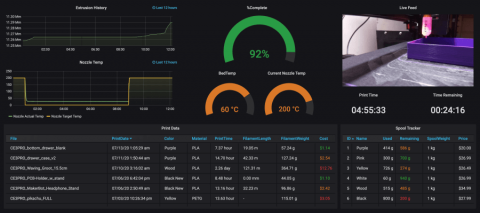
One of the most common dashboards for metric visualization and alerting is, of course, Grafana. In addition to logs, we use metrics to ensure the stability and operational observability of our product. This document will describe some basic Grafana operations you can perform with the Coralogix-Grafana integration. We will use a generic Coralogix Grafana dashboard that has statistics and information based on logs. It was built to be portable across accounts.