Operations | Monitoring | ITSM | DevOps | Cloud

How to choose between AWS RDS and EC2 Hosted Database?

You’ve decided to migrate your applications from on-premises to AWS and are considering what cloud services are available that suit your needs the best. When you are migrating an application that uses a relational database backend (RDBMS) such as Oracle, MySQL or SQL Server to the cloud, the question of RDS vs EC2 will inevitably surface.

Icinga for Windows Releasing v1.7.0 - Start your contribution

Today we are happy to announce, that Icinga for Windows v1.7.0 has been released! While this release includes lots of bugfixes for the Framework itself including the basic plugins, our main goal was to increase usability and make access for developers a lot easier.

Game Launches Should Be Exciting for Your Players, Not for Your LiveOps Team

The moment of launching something new at a game studio (titles, experiences, features, subscriptions) is a blockbuster moment that hangs in the balance. The architecture—distributed and complex, designed by a multitude of teams, to be played across a variety of devices in every corner of the world—is about to meet a frenzy of audience anticipation, along with the sky-high expectations of players, executives, and investors.

Your Ops and DevOps teams need to work together, and fast. Who you gonna call?

The world is moving fast, led by an ever-accelerating IT landscape. In recent years, two distinct types of teams have emerged that assist in driving this business transformation: DevOps/SRE teams that are in charge of driving rapid innovation of products and services, and IT Ops/NOC teams that focus on preventing outages and maintaining the high level of quality, reliability and serviceability that modern, discerning customers expect.

Anodot Acquires Pileus to Transform the Cloud Cost Optimization Space

We couldn’t be more excited here at Anodot at the announcement of the acquisition of Pileus. Acquiring a company is a very special event, a moment that is the culmination of months of thought and deliberation. Is there a strong synergy between the two entities? Do we share the same DNA and culture? Is the additional product aligned with our long-term vision?

Kubernetes Application-Level API

The Kubernetes API is the front end of the Kubernetes control plane and is how users can interact with their clusters. In essence, it’s the interface used to manage, create, and configure the cluster and the state of objects. Using a standard API, Kubernetes allowed teams to focus on constructs and consume infrastructure across different providers.

What do Top-Performing IT Organizations do Differently Than the Rest of Us?

The whole point of monitoring and managing your IT services is to ensure that they’re able to keep business services available and responsive to customer demands. But how do you actually quantify the return on investment you get from your IT performance management solutions? Digital Enterprise Journal set out to answer that question in its new research study, The Total Business Impact of IT Performance.

How Playbooks improve customer service delivery, agent productivity

We all know one bad experience can impact a customer’s perception of—and even willingness to deal with—an organization going forward. That’s why so many companies, in virtually every industry, have made investing in customer experience (CX) a top priority, according to ResearchAndMarkets.com. The problem is, for any given organization, there are a number of customer service processes along the entire life span of an interaction that need to be looked at and made great.

The Future of Private Addresses: Goodbye NAT, Hello IPv6

When the internet was first developed, the IP addressing scheme was IPv4. This addressing scheme worked really well for about 25 years. After all, it had about 4 billion host addresses. But as the internet grew, we started to see that this was just not going to be enough. Now we have an entire infrastructure that was built on IPv4. While IPv5 addresses have been exhausted, we’ve used band-aid solutions to keep the internet growing.

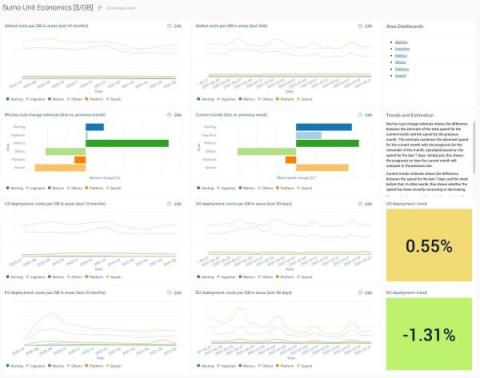
How Sumo Logic monitors unit economics to improve cloud cost-efficiency

An often overlooked aspect of a company’s journey to the cloud is cost visibility. While the single number delivered by the cloud provider on a monthly invoice is straightforward, understanding where this number comes from is often more tricky. Fortunately, this task can be facilitated through the usage of various cost monitoring tools available on the market, coming from both third-party companies and the cloud providers themselves.