Operations | Monitoring | ITSM | DevOps | Cloud

Monitor Supabase databases and Edge Functions

When cloud service providers first started popping up, many developers were “wowed” by being able to spin up and scale all kinds of infrastructure to deploy their web applications on demand. However, big-box cloud service providers are often complex to use, scaling out is expensive and default monitoring solutions are not very insightful. Besides, we are spoiled developers, and we expect things to be easy.


Sending PHP Single-Page Application Logs to Loggly

In this post, we’ll embark on the journey of building a simple PHP single-page application that interacts with a MySQL database. We’ll integrate logging functionality on top of our application. Logging is a crucial aspect of any application—for providing insights into user behavior, tracking errors, and monitoring performance. We’ll start by walking through how to set up our application.

Patch Management Software: Your Guide to Picking a Patch Manager (with Examples)

Patch management software automatically applies updates to software, firmware, and other system components. Patching makes sure resources are up to date with the latest security and performance improvements to keep software protected and performing as expected.

Limit deployments to Upsun only when Git tagged: part two

In part one of this series, we covered how you could limit deployments to Upsun only when a tag is pushed/created, focusing primarily on using GitHub and the GitHub Actions platform to accomplish this goal. But we’re a polyglot PaaS and strive to be agnostic in our users’ source code management terms of the service. With that in mind, let’s look at how we can accomplish the same goal using GitLab and your CI/CD system. Just like last time, there are some assumptions to consider.

Charting New Territory: OpenTelemetry Embraces Profiling

The topic of continuous profiling has been an ongoing discussion in the observability world for some time. I said back in 2021 that profiling was set to be the next major telemetry signal in observability, and in fact, since then there’s been growing interest in profiles. Startups and large observability vendors have gotten into this domain. A significant recent step was when the OpenTelemetry project decided to add profiles to its core signals and formalized the open unified specification for that.

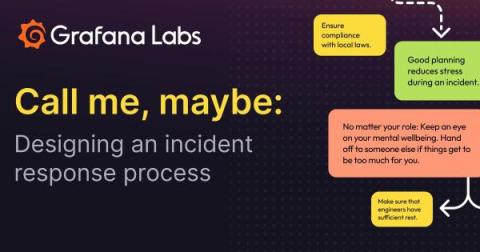
Call me, maybe: designing an incident response process

Hey, I just deployed — and this is crazy. But the server’s down, so call me, maybe? Making your services available at all times is the gold standard of modern software operations. The easiest way to reach this would be to just write bug-free software, but even if you reach this completely unattainable goal — stuff happens! Modern software rarely exists in a vacuum and often depends on a multitude of external services and libraries.

Observability Unpacked: 5 Takeaways From KubeCon + CloudNativeCon 2024

StackState had a blast at this year's KubeCon + CloudNativeCon gathering in Paris! The discussions were in-depth, covering a wide array of topics and lasting much longer than in the past. This year, attendees seemed to have a considerably deeper understanding of the cloud-native ecosystem, probably attributed to its rapid growth. We also noticed a pretty dramatic evolutionary shift in the vendors at the expo hall, who were showcasing some truly progressive specialized solutions.

One Reason Why Your Nodes' Memory Usage Is Running High

When you’re using Cribl Stream and Cribl Edge to send data to hundreds of Splunk indexers using Load Balancing-enabed Destinations, it is sometimes necessary to analyze memory usage. In this blog post, we delve into buffer management, memory usage calculations, and mitigation strategies to help you optimize your configuration and avoid memory issues.

Heroku: the PaaS of the Past Struggles To Keep Up

If there's one thing almost every developer has done in their life, it's deploy an application to Heroku. From their launch in 2007, Heroku dominated PaaS and caught the attention of Salesforce who acquired them in 2010. They had the first managed Postgres service in 2011, an easy to use CLI, and, last but not least, it was free to get started which led to a big uptick in initial popularity. Every side project from here to the moon went to Heroku.

Three Ways to Assure Network Quality

What is the quality of your network? More to the point, what is the quality of the network experience? Do your employees think that your network is slow? Merely adequate? Speedy? At the highest level, this is what network operations teams need to understand how to answer. And this needs to be answered no matter how complicated the network path is between endpoints. We’ll take a look at three things that can help you get a handle on these questions.