Forethought is a leading AI company providing customer service solutions that transform the customer experience. As a high-growth startup with a fast-expanding engineering org., teams had to deal with compounding complexity, leading to challenges measuring the impact and health of their services. Forethought’s core engineering team maintains common services between other internal teams, infrastructure, data, and tools and, as they added more engineers, the original team split into five.
We recently partnered with GameCI to bridge the gap between CircleCI and the game development scene. This partnership brought forth the Unity orb, a reusable component of config you can plug into your CircleCI configuration file to build and test your Unity projects. For a while now, continuous integration and delivery have been part of the software development cookbook of several software houses and IT departments. However, this is often not the case in game development.
To improve reliability, we need to measure it, and to measure it we use SLOs (Service Level Objectives). Or at least, that’s what Google SRE has popularized. In practice, it can be difficult and time-consuming to identify the right things to measure, to get to the right data, and to surface the results in a way that engages the stakeholders and teams involved. And all this is especially hard as we scale our teams and applications across multiple technology stacks.
One of Icinga’s greatest strengths is its ability to integrate with other systems and use those systems’ data to enrich monitoring. It can write time-series data to InfluxDB, Graphite or even Prometheus with our icinga2-exporter. It can talk to different data sources so that hosts and services can be created and managed automatically. This means that lots of manual work is eliminated.
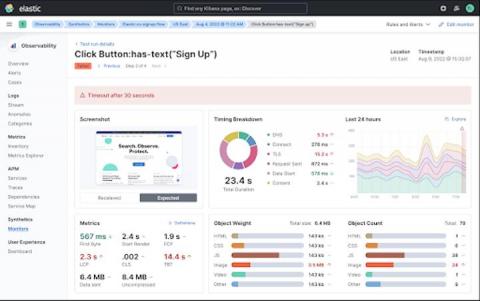
From its inception as a powerhouse for logging, Elastic Observability has grown into a comprehensive solution for full-stack multi and hybrid-cloud observability. Given the increasing complexity of the cloud-native world, the major challenge for observability is twofold: getting deeper and more frictionless visibility at all levels of applications, services, and infrastructure, and making sense of the overwhelming amount of data that is available.
The Cambridge English Dictionary defines a silo as “a part of a company, organization, or system that does not communicate with, understand, or work well with other parts.” Siloing can exist at various organizational levels: siloed departments, siloed teams within a department, and even siloed engineers within a team. In any industry, siloing can cause issues with alignment, communications, and overall delivery, but in fintech, there are additional risks.