Operations | Monitoring | ITSM | DevOps | Cloud

Bunnyshell Named Startup of the Year 2024 in Palo Alto by HackerNoon

"If AI is writing the code, we make sure it runs." Alin Dobra, Founder Bunnyshell We’re proud to announce that Bunnyshell has been named Startup of the Year 2024 in Palo Alto by HackerNoon! This recognition reflects the work we’ve done to build the Software Delivery Platform for a new era—where code is written by AI, but validated by real environments.
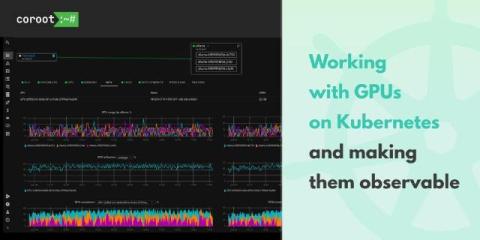
Working with GPUs on Kubernetes and making them observable

GPUs are everywhere powering LLM inference, model training, video processing, and more. Kubernetes is often where these workloads run. But using GPUs in Kubernetes isn’t as simple as using CPUs. You need the right setup. You need efficient scheduling. And most importantly you need visibility. This post walks through how to run GPU workloads on Kubernetes, how to virtualize them efficiently, and how Coroot helps you monitor everything with zero instrumentation or config.

Hyperparameter tuning for LLMs using CircleCI matrix workflows

Hyperparameter tuning is a critical step in optimizing large language models (LLMs). Parameters such as learning rate, batch size, weight decay, and number of training epochs can significantly affect convergence behavior and final model performance. While several approaches like grid search or random search are widely used, executing them manually is inefficient; especially when each training run is compute-intensive.

Announcing Go tracer v2.0.0

Datadog has long supported the monitoring of instrumented Go applications through our Go tracer v1. As the Go ecosystem has continued to mature, we’ve been hard at work collecting feedback and improving upon the tracer’s capabilities and usability features. We are now thrilled to announce the release of our Go tracer v2.0.0. This major update includes better security and stability, and a new and simplified API.

From RPA to Agentic AI: Understanding the Shifting Landscape of Enterprise Automation

Over the past decade, organizations have embraced automation in waves – starting with basic task scripts and Robotic Process Automation (RPA), then moving to hyperautomation, and now exploring “agentic AI” as the next frontier. Each step in this evolution has expanded the scope of what can be automated, and revealed new challenges. This blog offers a detailed comparison of RPA, hyperautomation, and agentic AI, their key differences, strategic advantages, and potential drawbacks.

Blueprints: Ready-Made Processor Bundles For Your Telemetry Pipelines

We’ve noticed a lot of our customers spend countless hours building and configuring processors. Either parsing JSON, standardizing log formats, normalizing timestamps, masking PII, de-duplicating logs, the list never ends. Most work revolves around recreating the same processor bundles in multiple processor nodes. Bindplane’s new Blueprints solves that boring, repetitive work by providing pre-built processor bundles you can drop into any pipeline with a single click.

Why Cribl Copilot Editor is Built for the Human, First and Foremost

I’m genuinely excited about what we're rolling out with Copilot Editor, an update to our AI that’s truly packed with new capabilities designed to help you automate pipeline development. You can read about these capabilities here. I wanted to take a moment to share our thinking on a core principle that guides how we build, especially regarding the impactful, and sometimes daunting, world of generative AI.