How to use the plugin library in Pandora FMS
Using the Pandora FMS library is very easy, and that is why we show you how to search and download elements in this short video.


The latest News and Information on Monitoring for Websites, Applications, APIs, Infrastructure, and other technologies.
As Teams Phone becomes the norm in the Enterprise space, managing the quality of service delivery and user satisfaction, whether it’s cloud or connected to the PSTN, is mission critical. Teams PSTN calls are used for just about every type of meeting as well as for Contact Centers, Customer service, town halls and client pitches. Because of this ubiquitous usage, Enterprise IT needs analytics to understand how this service is performing for users and when problems are occurring.
Our own CEO, Dave Link, sat down with the Senior Vice President of the EMEA region, Clive Spanswick, for an interview to discuss ScienceLogic’s rapid growth in EMEA. Here’s an excerpt of their conversation.
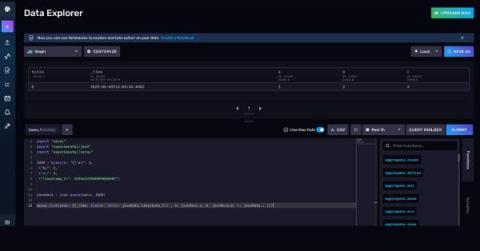
There are multiple ways to use Flux to bring in data from a variety of different sources including SQL databases, other InfluxDB Cloud Accounts, Annotated CSV from a URL, and JSON. However, previously you could only manually construct tables from a JSON object with Flux as described in this first example. We’ll describe how to work with three examples with increasingly complex JSON types. First we will describe how to work with these JSON types with metasyntactic examples.
When it comes to your analytics tools, would you say they’re getting easier to manage overall, or is it increasingly difficult? Can you easily scale to meet new compliance requirements, or is there so much custom work required that the pace of change is too much for your team to handle? Do you feel in control over how and where your observability data flows, or do you feel beholden to your vendors? This blog post will shed light on how you can ease the strain on your downstream systems.
Bigeye is the data observability platform that teams at companies like Zoom and Instacart use to keep their data pipeline fresh, high quality, and reliable. Their customers depend on them to detect problems in their data pipelines 24/7 and to keep data reliable enough for production use cases of analytics and machine learning. In this environment, margins for error are razor thin and waiting for a user to let you know that something isn’t working means it’s already too late.
Greetings friends, one and all! Over here on the Field Engineering team, we’re often asked about tracing. Two questions that come up frequently: Do I need to sample my traces? and How do I sample my traces? The folks asking are usually using tracing stores where it’s simply not possible to store all of the traces being generated. Those are great questions and the answers depend on a few different factors.