Operations | Monitoring | ITSM | DevOps | Cloud

The latest News and Information on Monitoring for Websites, Applications, APIs, Infrastructure, and other technologies.

How Netdata gets you from 0 to monitoring in minutes

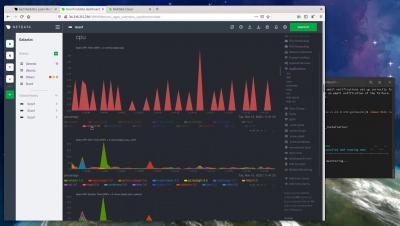
Netdata is zero-configuration monitoring. It’s a principle that we’ve stood behind since the project’s beginning, when it was only our CEO Costa trying to solve a “painful, real-world problem,” and it’s one we stand by today. Our insistence on zero-configuration guides every product decision we make, every grooming process, and every React component our frontend teams design.


Welcome to Netdata's community repository: Consul, Ansible, ML

On our journey to democratize monitoring, we are proud to have open source at the core of both our products and our company values. What started as a project out of frustration for lack of existing alternatives (see anger-driven development), quickly became one of the most starred open-source projects on all of GitHub.

An Introduction to our New Product: Logz.io Distributed Tracing

Yesterday we were excited to announce Logz.io Distributed Tracing, the most recent addition to our Cloud-Native Observability Platform. This is such a special launch for us because it makes Logz.io the only place where engineers can use the best open source monitoring tools for logs, metrics, and traces – known as the ‘three pillars’ to observability – together in one place.

Barbara Nelson | How Can I Put That Dashboard in My App? | InfluxDays

Many users love using the InfluxDB UI to visualize their time series data in a variety of different graphical representations. In this session, Barbara Nelson will show how to use Giraffe (the React-based visualization library powering the data visualizations in InfluxDB 2.0 UI) to visualize your time series data within your own app. You can bring the power of our visualization tools to your users, directly in your app, instead of requiring them to login to the InfluxDB UI to see a visual representation of your data.

Go from 0 to monitoring in minutes with Netdata

Netdata is zero-configuration monitoring. It’s a principle that we’ve stood behind since the project’s beginning, when it was only our CEO Costa trying to solve a “painful, real-world problem,” and it’s one we stand by today. Our insistence on zero-configuration guides every product decision we make, every grooming process, and every React component our frontend teams design.
User Experience Monitoring and Synthetics with Elastic Observability

Elastic Observability 7.10 introduces exciting new capabilities that bring deeper visibility into the most important layer of digital monitoring — the experience of the end user. User experience monitoring — accessed via a brand new app in Kibana — provides real-time visibility into website performance, and multistep journey checks in Uptime significantly expand synthetic monitoring capabilities to help operational teams proactively catch issues by monitoring simulated journeys. Plus, several new features like searchable snapshots, out-of-the-box anomaly detection jobs for infrastructure monitoring, and a PHP agent for Elastic APM help the Elastic Observability community optimize costs while deepening visibility across operations.

Observability with Context: Telemetry, Time, Tracing, and Topology

That’s the question ops personnel have been asking for decades whenever something goes wrong in the production IT environment. Everything was working before, so the reasoning goes, and now it’s not. We have an incident. And to figure out what caused the incident – and hence, to have any idea how to fix it – we must know what changed. There’s just one problem with this approach. What if everything is subject to change, all the time?

PuTTY from a monitoring perspective

PuTTY is a free program (MIT license) for x86 and AMD 64 architectures (now in experimental stages for ARM). It was developed in 1997!, by Simon Tatham, a British programmer. In this blog, we have been reviewing this useful program for several years, and even the great Pandora FMS team has confirmed it just now in 2020, in the list of network commands for Microsoft Windows® and GNU/Linux®. What if it deserves its own article? Read and judge for yourselves.