Operations | Monitoring | ITSM | DevOps | Cloud

The Place Where Modern Operations & Technology Come Together

The latest News and Information on Monitoring for Websites, Applications, APIs, Infrastructure, and other technologies.


Unlocking business resilience with full-stack observability in hybrid IT environments
For CIOs and technology leaders across the Gulf Cooperation Council (GCC), full-stack observability is a strategic lever for achieving faster ROI, operational resilience, and digital maturity. By integrating AI-powered insights and automation, IT leaders can streamline operations and align technology outcomes with business goals. Demonstrating ROI within tight timelines is critical, as is leveraging observability to maintain competitive advantage in a rapidly evolving market.

OpenTelemetry support for .NET 10: A behind-the-scenes look
At Grafana Labs, we are fully committed to the open source OpenTelemetry project and are actively engaged with the OTel community. Many Grafanistas spend a large proportion of their time contributing directly to OpenTelemetry upstream projects, helping make observability more powerful, reliable, and accessible for everyone as part of our big tent philosophy.

Teaching AI How to Refinery
At the beginning of February, we released v3.1 of Refinery, our advanced, tail-based sampling solution. The new version comes with more performance enhancements, bug fixes, and a few new pieces of telemetry. In tandem with the 3.1 release, we also released a new tool for our MCP server which helps your AIs understand Refinery, and how Honeycomb handles sampling.

The New Standard for Operational Decision-Making: Why Trustworthy Guidance Matters More Than Ever
Modern IT operations sit at the center of revenue, customer experience, and business continuity. Every decision engineers make influences far more than the technical domain, which is why teams need intelligence they can validate, reasoning they can understand, and guidance they can rely on. In an environment shaped by rapid change and expanding dependencies, decisions must be grounded in accuracy and context to avoid unnecessary risk.

From random chunks to real code - wiring up Next.js source maps in Sentry
When you ship a Next.js app, the React and TypeScript you write aren’t what your users actually download. Next.js compiles, minifies, splits, and shuffles your code into chunks in ways that are great for performance and terrible for debugging. This post shows you how that pipeline works, how source maps and debug IDs connect it all back to your original code, and how to wire things up so Sentry shows you real file names and line numbers instead of an unreadable stack trace.

What is the Model Context Protocol (MCP)
The Iron Man’s J.A.R.V.I.S. is the artificial intelligence (AI) that almost every person wants to see. A conversational technology that answers questions like a friend would. The rise of large language models (LLMs) almost seems to give people the friendly robotic sidekick that generations of children grew up dreaming about.

How a Singleton Pattern Broke Our Django Logging
With modern tooling and agentic coding assistants, straightforward bugs are almost a relief. If a test can catch it, or a user can reproduce it, chances are you can squash it quickly. The harder category — and the one worth writing about — are the bugs where everything looks correct. Your code runs, no exceptions are thrown, your debug statements confirm the right functions fire at the right times, and yet nothing works.

Already Love Scout APM? We Have Integrated Error Monitoring!
The error monitoring scene has changed a ton over the past few years. We've gone from basic exception tracking to fully integrated platforms that correlate errors with performance metrics and logs. We’ve even got AI-powered debugging! But in the midst of the AI explosion, some things remain unchanged and most teams are still drowning in data with little actionability.
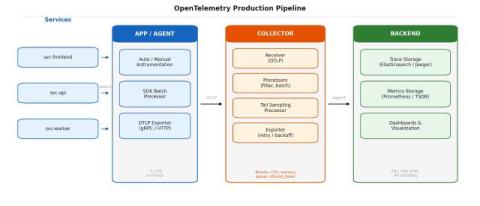
OpenTelemetry Production Monitoring: What Breaks, and How to Prevent It
OpenTelemetry almost always works beautifully in staging, demos, and videos. You enable auto-instrumentation, spans appear, metrics flow, the collector starts, and dashboards light up. Everything looks clean and predictable. However, production has a way of humbling even the most carefully prepared setups. When real traffic hits, and it always spikes sooner or later, you start seeing dropped spans.