Operations | Monitoring | ITSM | DevOps | Cloud

The latest News and Information on Observabilty for complex systems and related technologies.

Top 9 LLM Observability Tools in 2025

Organizations are adding GenAI to their current and future architectures and product roadmaps, requiring Ops teams to ensure LLMs are accurate, fast, secure and cost-efficient. LLM observability tools directly addresses these needs, helping identify and prevent common LLM errors and issues: LLM observability provides the telemetry data for this analysis. LLM observability tools trace requests end-to-end, evaluate outputs, and correlate quality with latency, cost, prompts, tools, and data sources.

OpenTelemetry + ignio: The Foundation for Intelligent, Unified Observability

In the previous post, What is OpenTelemetry?, we went over the What, Why, and the How of OpenTelemetry. We also went over the telemetry data lifecycle (data generation à collection à storage à usage) and how telemetry data (MELT) could be put to use to troubleshoot a representative web application scenario.

Real Estate App Development for Ops & Product Teams: From MVP to Scale

In the competitive world of real estate technology, developing an app that can scale from a Minimum Viable Product (MVP) to a fully-fledged solution is crucial. For operations and product teams, this journey involves strategic planning and execution to ensure the app meets evolving market demands and user expectations.

Announcing Honeycomb for Frontend Observability React Native Beta

React Native apps straddle two worlds: JavaScript powering your UI and native modules running underneath. Add in backend services, and when something goes wrong, there are many possible culprits. Was it JS logic, the native bridge, the native API call, or a downstream API call? Most tools give you parts of the picture. A crash tool can tell you where the app failed but not what else happened in a session.

Redis Performance Monitoring: Combine Logs and Metrics for Complete Visibility

Redis earns its place in modern stacks because it’s an in-memory data store with microsecond latency and rich data structures, making it perfect for things like caching, sessions, and rate limiting. Since it often sits on the request path, small issues (connection churn, blocked commands, memory pressure) can quickly ripple into user-visible incidents.

Observability-as-Code: Bring synthetic monitoring into your pipeline

Your team just deployed to production. The infrastructure spun up in 90 seconds, but recreating your monitoring? That’ll take hours. It’s added late in the process, managed through dashboards, and prone to inconsistency. Short-term, this slows delivery and creates visibility gaps that surface only during incidents. Long-term, it leaves a business-critical capability out of your observability pipeline.

Scaling Datadog observability: 1,000 integrations and counting

Integrations have always been central to the Datadog platform, enabling customers to collect the data they need directly from the technologies they use every day. By unifying signals from infrastructure and applications to security and SaaS applications, teams gain both high-level visibility and the ability to drill into the details that matter the most. With more than 1,000 integrations now available, the Datadog ecosystem continues to expand alongside the platforms our customers rely on.

The observability maturity curve: How IT leaders are shifting from tools to outcomes

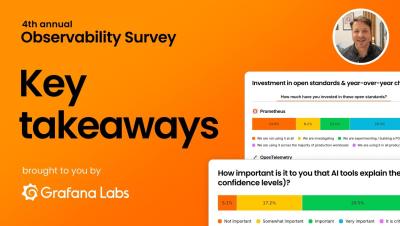
Observability has come a long way from its origins in monitoring logs and metrics. Today, it sits on a maturity curve: Organizations move from fragmented tool stacks to unified platforms to proactive engineering practices that tie reliability to business outcomes. To better understand where IT leaders are on this curve, Grafana Labs surveyed 150 decision-makers across industries in advance of ObservabilityCON 2025.

Observability vs. Visibility: What's the Difference?

In modern IT systems—distributed services, cloud-native platforms, and dynamic networks—just knowing that something is “up” isn’t enough. Green checkmarks on dashboards don’t tell you why performance shifted, why latency crept in, or why a perfectly healthy-looking service suddenly failed. This is where the conversation around visibility and observability begins. They sound similar, but they solve very different problems.

What the 2025 DORA Report Teaches Us About Observability and Platform Quality

The 2025 DORA State of AI-Assisted Software Development Report delivers a critical insight for technology leaders: AI is fundamentally an amplifier, not a solution. It magnifies the strengths of high-performing organizations with robust observability while exposing the dysfunctions of struggling ones. For organizations that have rushed to adopt AI coding assistants all while expecting immediate productivity gains, this finding demands a strategic pivot.