Operations | Monitoring | ITSM | DevOps | Cloud

The latest News and Information on Observabilty for complex systems and related technologies.

Background Job Observability Beyond the Queue

Background jobs handle the critical work that happens outside the request path: processing payments, sending emails, generating reports, syncing data. They keep applications running smoothly, but the signals they produce look different from API endpoints. Most teams start with queue metrics—how many jobs are waiting and how quickly they complete. These metrics provide the foundation, but job health extends beyond throughput.

What is Service Catalog Observability and How Does It Work?

A service catalog gives teams a shared view of their systems—what services exist, who owns them, how dependencies are structured, and the SLAs that guide expectations. It’s an important part of development infrastructure because it helps everyone speak the same language about services. Service catalog observability builds on that foundation.

Introducing Cost Meter - Proactive Observability Cost Control with Per-Hour Granularity

The irony isn't lost on us - observability platforms are built to be proactive about system health, yet when it comes to managing observability costs themselves, teams are forced to be reactive. Today, that changes with Cost Meter, now live in our platform. Cost Meter transforms observability spend management from a monthly billing surprise into a proactive, data-driven process with hourly aggregated metrics that give you complete visibility into your telemetry ingestion patterns.

APM vs Observability: Observing beyond APM

In my previous post I made a bold, sweeping statement that APM is not - in the most specific sense - a subset of observability. Still standing by it I stand by that because words matter and - like many "monitoring engineers" (IT folks who make monitoring and observability their specialty) - I, too, bear scars from the flame-wars on Twitter back in the 2020's where we fought internecine battles over the proper definition of (and number of pillars in) “observability”.

Introducing Honeycomb Intelligence Canvas

Canvas is an AI-guided workspace inside Honeycomb that combines an AI assistant with an interactive notebook for visualizing query results and traces. You can ask a natural language question about your data and Canvas will immediately start exploring your traces, through multiple queries and other tools, to find the right next steps. Instead of having to write each query yourself, Canvas automatically proposes relational queries, comparisons, and visualizations that explain why an SLO fired or what changed after a deploy.

Pastries with SREs: Limitless observability and uncompromised donuts

In this episode of Pastries with SREs, we dig into Limitless Observability with a sweet side of unified observability strategy. If you're tired of siloed tools, fractured data, and swivel-chair investigations, this one’s for you. We explore: Why are silos still the norm in modern observability? What’s the true cost of inefficiencies across logs, metrics, and traces? How can SREs, IT operations, and dev teams shift to a no-compromise, unified observability model?

Meet Canvas: Your AI-guided Workspace Within Honeycomb

Modern systems are wonderfully capable, but relentlessly complex. Debugging across microservices, frontends, and cloud edges often means switching between five or more tools, trying to stitch together “what changed” and “why it broke.” Honeycomb’s wide events model has proven to be a superpower for taming that complexity, by allowing you to easily observe and query end-to-end traces without worrying about how much granular data you attach to your events.

Full-Stack Observability with VictoriaMetrics in the OTel Demo

The OpenTelemetry Astronomy Shop is a widely used demonstration environment designed to illustrate the concepts and practical implementation of observability in distributed systems. Built as a microservice-based e-commerce application, the demo provides developers with a near real-world environment where they can explore how telemetry data—metrics, logs, and traces—can be collected, processed, and visualized.

Introducing Anomaly Detection: Your Early Warning System for Service Health

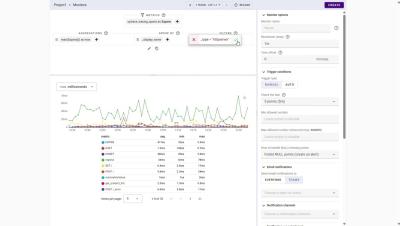
Modern engineering teams face a persistent challenge: knowing when something goes wrong before their customers do. With microservices architectures sprawling across dozens or hundreds of services, creating comprehensive alerting becomes an overwhelming task. You're left playing whack-a-mole with manual alert configurations, often missing critical issues or drowning in false positives.