

Operations | Monitoring | ITSM | DevOps | Cloud

Digital ID Arrives at the Till: What the Alcohol Rule Change Means for Checkout Integrations

For years, proof of age at an alcohol till in England and Wales meant something you could hold in your hand: a passport, a photocard driving licence, a PASS card. That's no longer the whole list. Since mid-September 2026, licensed premises can accept certified digital proof of age from a customer's phone.
Foundation first: Why building a resilient IT infrastructure is your path to AI-readiness

Strategically ready, operationally unsure. That's how 42% of organizations describe their own AI preparedness when it comes to strategy versus infrastructure, data, risk, and talent, according to Deloitte's State of AI in the Enterprise 2026 report. As AI adoption accelerates, organizations now face the mounting pressure from the board to move past pilots and show AI delivering measurable business outcomes.
Sponsored Post

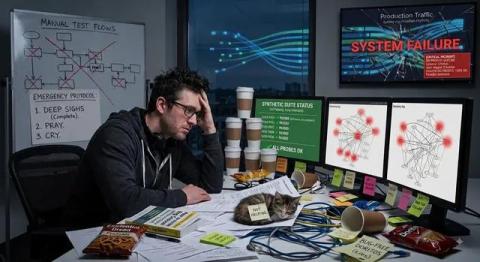
Synthetic Monitoring Is Broken. Your Production Traffic Can Fix It.

Synthetic monitoring has been a critical part of application reliability for years. It gives engineering and operations teams a way to proactively test applications, APIs, and critical customer journeys before users encounter problems. But there is a fundamental limitation with the traditional approach: Someone has to create the tests. As applications become more distributed and customer journeys become more complex, organizations can end up maintaining hundreds or even thousands of synthetic scripts. Every new feature, API, dependency, or change to a customer journey can require another update.

Is your most expensive talent spending valuable time writing status updates?

A major incident can turn a highly skilled engineer into a coordinator, a search engine, and a status writer. The work looks necessary in the moment. The cumulative effect is easy to miss: the people most needed to understand the failure spend their time repeating what others already know.

The 5 Stages of AI-Human Collaboration to Improve Operational Reliability

AI adoption is now a measurable driver of both uptime and growth. According to PagerDuty’s 2026 State of AI-First Digital Operations report, 75% of organizations actively incorporating AI into digital operations claim to have improved operational resilience and maturity over the past year. The same report suggests AI in operations is also a revenue driver.

When users don't click thumbs up: Inferring agent feedback from Datadog telemetry

Collecting high-quality user feedback on agents, like from thumbs-up or thumbs-down buttons, is an important part of agent development. User feedback is needed for everything from basic gut checks on whether your agents are behaving well to planning and creating robust eval sets. It’s a critical part of Datadog’s Agent Observability, which provides explicit end-user feedback features for collecting and analyzing it.

Cut AI agent cost and improve accuracy with Code Execution in the Datadog MCP Server

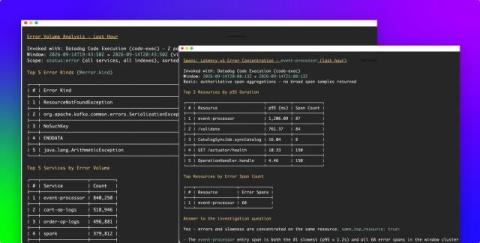
Observability investigations rarely follow a straight line. A latency question might cause an AI agent to start with a metric, pivot into traces, compare a deployment window, and finish by reducing thousands of logs to a few patterns. Each individual query is easy, but propagating context throughout an entire investigation can be tricky and expensive.