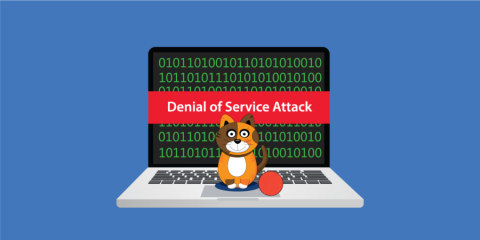
Introducing XDP-optimized denial-of-service mitigation
In this article, we’ll explore Calico’s denial-of-service (DoS) mitigation features, including XDP-optimisation support introduced in Calico v3.7.


In this article, we’ll explore Calico’s denial-of-service (DoS) mitigation features, including XDP-optimisation support introduced in Calico v3.7.
Java applications deployed in production must be multi-threaded for scalability. Threads can be used for performing different tasks or they could be executing the same task to service different user requests. Often, it is necessary to synchronize between different threads.
Today we bring you a comparison: OpenNMS vs Zabbix vs Pandora FMS. Three titans of open-source software, without a doubt. We will see its main features and we will talk about the business model of each company -free does not necessarily mean for free- and we will summarize with graphic information. Three monitoring solutions that are rather projects: these are software made by companies that share their code with everyone and that can be used -and modified- by anyone.
Last Friday May 31, Nicolas Beauvais, CTO and only tech person of small startup raisup.com, took to Twitter with a cry for help. Their cloud hosting company Digital Ocean had just locked their account and made it clear that this was permanent.
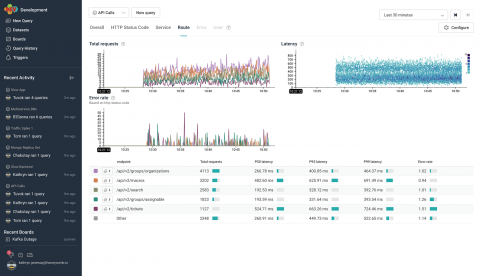
Our latest product update features an intuitive home (landing) page that orients users with a quick, real-time view into what’s happening right now in your production systems. Home displays commonly used queries and breakdowns, and provides a jumping-off point to explore data about what’s happening in production.
The OpsRamp Summer 2019 release delivers comprehensive features for modern infrastructure management with intelligent hybrid monitoring and contextual event correlation. The new release delivers AIOps innovations such as OpsQ Observed Mode and auto-alert suppression management along with enhanced network topology maps and new cloud native monitoring capabilities.
Distributed tracing has become a de-facto standard for monitoring distributed architectures, helping engineers to pinpoint errors and identify performance bottlenecks. Zipkin is one of the popular open source “tracers” available in the market, and I’m now happy to inform our users that we’ve recently introduced a new integration that allows users to easily ship trace data collected by Zipkin to Logz.io!
XDP or Express Data Path arises due to the pressing need for high-performance packet processing in the Linux kernel. Several kernel bypass techniques (DPDK being the most prominent one) aim to accelerate network operations by moving packet processing to user space.
TimescaleDB is an open source database packaged as a Postgres extension that supports time series, but “it looks as if it were just Postgres,” said Timescale’s Head of Product, Diana Hsieh. “So you can actually use the entire ecosystem. You can use all of the functions that are enabled in Postgres – like JSON indexes, relational tables, post JSON – and they all work with Timescale.”