Operations | Monitoring | ITSM | DevOps | Cloud

DevOps 101: Introduction to Package Management

When you’re new to an industry, you encounter a lot of new concepts. We tend to use a lot of jargon, the documentation may be written for someone more experienced in mind or rely on contextual knowledge of the rest of the space, and it often doesn’t explain the “why” for the tool. This can make it really difficult to get your feet underneath you in an unfamiliar landscape, especially for junior engineers.


8 Best Tools to Measure and Improve Your CRO

Marketers focus on driving traffic to their websites. However, this alone is not enough to sustain businesses. You can churn lots of leads from the massive traffic coming into your website, but this is all in vain as long as they do not convert. Your goal is to turn all your lead generation efforts into conversions; this is where the revenue flows in. Even though you may have tons of experience optimizing your conversions, success is never guaranteed.

Product Spotlight: Smart Tiering + LogMetrics to Optimize Costs

Is all observability data worth the same cost? If you guessed no, then you’d obviously be correct. Anyone familiar with the very nature of gaining targeted observability knows that some data points hold more value than others. Yet, many observability platforms still treat all types of log data the same, and as a result, related costs remain uniform. One of the most persistent observability challenges today is the cost of indexing log data.

APImetrics + Squadcast: Routing Alerts Made Easy

APImetrics is an API Compliance, Monitoring and Security solution that lets you make and run API calls or sequences of API calls (workflows) from external, remote cloud locations using exactly the same security configurations as a typical end user would use. If you use APImetrics for API calling requirements, you can integrate it with Squadcast, an end-to-end incident response tool, to route detailed alerts from APImetrics to the right users in Squadcast.

Goodbye LAN. The Internet is the Network.

We are at the cusp of an important technology transformation. A discontinuity in technology as Peter Drucker would call it (precipitated by Covid). For decades, IT organizations invested in building, managing, and monitoring LANs. Everything was on your local network: your CRM, your Exchange email, the file shares, and the print server. Today, many companies are shutting down their “old legacy network” and are running their enterprise without a LAN, WAN, or an OnPrem datacenter.

Understanding Your Amazon EKS Spend

Most customers running Kubernetes clusters Amazon EKS are regularly looking for ways to better understand and control their costs. While EKS simplifies Kubernetes operations tasks, customers also want to understand the cost drivers for containerized applications running on EKS and best practices for controlling costs. Anodot has collaborated with Amazon Web Services (AWS) to address these needs and share best practices on optimizing Amazon EKS costs.

What is MLOps?

MLOps is the short term for machine learning operations and it represents a set of practices that aim to simplify workflow processes and automate machine learning and deep learning deployments. It accomplishes the deployment and maintenance of models reliably and efficiently for production, at a large scale. MLOps is slowly evolving into an independent approach to the machine learning lifecycle that includes all steps – from data gathering to governance and monitoring.

Track maintainers and purpose for hosts in your infrastructure

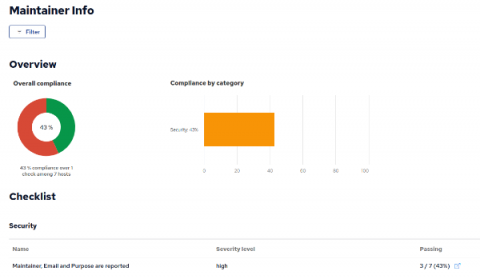
When something goes wrong or looks fishy for a particular host in your infrastructure how do you know who to ask about it? In an infrastructure managed by many and used by many it is also helpful to know what each hosts’ purpose is. In this article we show how to add maintainer and purpose information to individual hosts in your infrastructure via the CMDB feature of Mission Portal. We will also add a Build Module to add this information to the /etc/motd file for each associated host.

When to Use K3s and RKE2

K3s and Rancher Kubernetes Engine (RKE2) are two Kubernetes distributions from the SUSE Rancher container platform. Either project can be used to run a production-ready cluster; however, they target different use cases and consequently possess unique characteristics. This article will explain the similarities and differences between the projects. You’ll learn when it makes sense to use RKE2 instead of K3s and vice versa.

The Immutability of Time Series Data

Time series data often comes in large volumes that need to be handled carefully to produce insights in near real time. We’re constantly moving through time. The time it took you to read this sentence is now forever in the past, unchangeable. This leads to something unique about data with a time dimension: It can only go in one direction. Time series data is different from other data for many reasons.