Operations | Monitoring | ITSM | DevOps | Cloud

The latest News and Information on AIOps, alerting in complex systems and related technologies.

Episode 13 - AI: The Hidden Layer (Part 1)

What does enterprise AI look like when the user is no longer human? In this episode of The Intelligent Enterprise, host Tom Stoneman sits down with Ash Ashutosh, CEO of Pinecone and a three-time founder, to explore the next evolution of AI infrastructure: from vector databases built for humans using chatbots, to knowledge engines designed for AI agents that need to understand context, take action, and get work done.

AI-Powered Ransomware Is Here: How Agentic AI Is Changing Cybersecurity

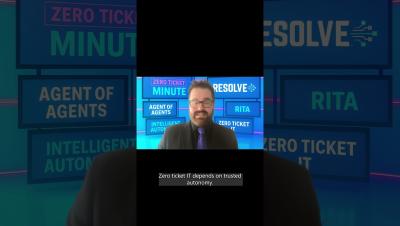
AI-powered ransomware is becoming a reality. Researchers recently demonstrated autonomous AI agents that can scout networks, steal credentials, and accelerate ransomware attacks. In this 60-second Zero Ticket Minute, learn what this means for cybersecurity, IT operations, and the future of agentic AI. Can AI also help stop these attacks? Watch to find out.

What is MTTR, and how can agentic ITOps reduce it?

Mean time to resolution (MTTR) measures the average duration to restore regular operation for an application, service, or infrastructure component. It’s a key performance indicator (KPI) for IT incident management. To tie MTTR directly to customer satisfaction, you first need to understand how it affects service and application reliability and availability. From there, you can make informed decisions, operate efficiently, and provide a seamless customer experience.

The NetOps Dashboard Era Is Closing: Our Take on Gartner's 'The Future of NetOps Is Agentic'

For roughly fifteen years, operating a network has meant living inside a vendor dashboard. An engineer’s skill was, in large part, the ability to read those panels quickly and act on what they showed. Gartner’s read in “The Future of NetOps Is Agentic” is that this arrangement is closing, and sooner than most teams have staffed for.

Dynamic MCP Server Demo | Connect AI Agents to Enterprise Automation with Resolve Actions Pro 8.1

Learn how to create and deploy a Dynamic MCP Server in Resolve Actions Pro 8.1 and securely expose enterprise automation to AI assistants using the Model Context Protocol (MCP). In this walkthrough, you'll see how to configure an MCP server, publish automation runbooks, connect to Claude Desktop, and execute enterprise workflows directly from an AI assistant. With Dynamic MCP Servers, organizations can make existing automation instantly accessible to AI agents without rebuilding workflows.

Automation That Protects, Not Replaces: The Human Side of AI-Driven Operations

Automation has a branding problem. For years, it has been associated with cost reduction and workforce replacement. But operators tell a different story. Across eleven interviews, the consistent theme was relief. Relief from manual ticket creation. Relief from repetitive triage. Relief from workflows that once required three days and now take five minutes. These are not stories about eliminating people. They are stories about protecting them. Operators spoke with clear ownership over their environments.

How to lay the data foundation to support agentic ITOps

Agentic IT operations have arrived. It’s no longer a question of if enterprise IT departments will adopt agentic ITOps, but how quickly. Every year, IT environments grow more distributed, complex, and difficult to monitor with legacy tools and processes. At the same time, the pace of AI development is accelerating the volume of changes and incidents, straining teams that are still trying to manage them manually, reactively, and one alert at a time.

Unlock AIOps with Red Hat Ansible Automation Platform and LogicMonitor Edwin AI

Edwin AI and Red Hat Ansible Automation Platform help ITOps teams move from correlated alerts and root cause analysis to governed, auditable remediation. When an outage starts, the first alert is only the first artifact. The harder work follows: grouping related signals, separating symptoms from cause, identifying the affected service, and deciding whether the next action is safe to run.

Stop Triaging in the Dark: Full Visibility Across Every IT Domain

Alert correlation solved the noise problem. But noise was never the whole problem. Today’s most disruptive incidents cascade across networks, infrastructure, applications, and services simultaneously, without clear visibility into the true root cause. As a result, L1 teams are left manually piecing together context from multiple dashboards and tools to find the primary root cause while SLA clocks keep ticking and end user tickets add up.