Operations | Monitoring | ITSM | DevOps | Cloud

The latest News and Information on Application Performance Monitoring and related technologies.

What is Python Application Performance Monitoring? - [A Complete Guide]

A recent study looked at real-world Python programs and found something important: Python isn’t the main reason apps slow down. The real problems come from inside the code like poor logic, memory issues, and slow database queries. The problem is, these issues often go unnoticed. Your app may seem fine until users start complaining about slowness or things start breaking under pressure.

From Sequential Bottlenecks to Concurrent Performance: Optimizing Log Processing at Scale

We optimized log processing pipeline by moving from sequential to concurrent processing at the entry level, achieving 30% higher throughput and better resource utilization without increasing infrastructure costs. When customers start sending millions of logs per minute, you quickly discover whether your processing pipeline can actually scale with vertical scaling.

The Hidden Cost of Not Using APM in Production

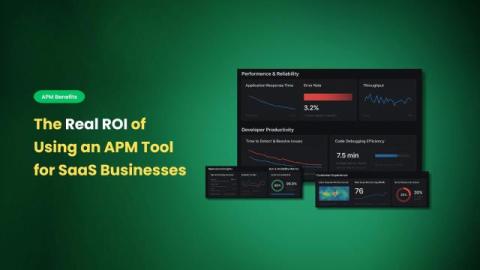
Many organizations don’t realize how important it is to monitor how their applications run in production. Without Application Performance Monitoring (APM), it becomes difficult to detect and resolve issues quickly, leading to increased downtime, wasted developer effort, and poor user experience. These hidden costs, though not always visible at first, can impact customer satisfaction, reduce team efficiency, and result in lost revenue.

Golang Application Performance Monitoring: A Comprehensive Guide

Application Performance Monitoring (APM) refers to the practice of tracking, analyzing, and optimizing the performance and availability of software applications. When it comes to Go (Golang), a language known for its concurrency, speed, and efficiency, APM becomes crucial to ensure that your applications stay fast, reliable, and scalable under real-world loads. APM in Go involves monitoring the runtime behavior, request response times, system resource usage, and error patterns across your application.

I built an MCP Server for Observability. This is my Unhyped Take

Recently, I read a blog titled “It’s The End Of Observability As We Know It (And I Feel Fine)”, which discussed MCP servers in observability and how these systems would potentially be the “end of observability”. As someone who has spun up an MCP server for an observability backend and as someone who has been in the space for a while, I certainly do not think so.

Cloud or Self-Hosted - Which Deployment Model is Right For You?

Choosing the right observability platform is a critical decision. But how you deploy it is just as important. The right deployment strategy can accelerate your team, simplify operations, and ensure you meet compliance and security requirements. The wrong one can lead to operational headaches and slow you down. At SigNoz, we believe in flexibility. There is no single "best" way to deploy an observability platform; there's only the way that's best for you.

How APM Can Improve Your Digital Customer Experience?

When a customer taps a button, submits a form or waits for a page to load, they’re not thinking about your backend architecture, microservices, or CDN; they want it to work instantly. But when it doesn’t, the frustration is immediate. Maybe the app freezes. Maybe a checkout fails. Maybe the entire experience just feels laggy. And the worst part? They don't complain, they just leave the application.

Getting started with Dynatrace dashboards

Dynatrace gives you incredibly deep observability data. But all that depth can bury the insights needed. In this blog, we show how to turn Dynatrace's complex telemetry into visual dashboards that actually make sense. Dynatrace is a leading observability and application performance monitoring (APM) platform, known for its deep insight into complex, modern cloud environments. With capabilities spanning infrastructure monitoring, real user monitoring, and security, Dynatrace offers powerful telemetry.

Kubernetes Observability with OpenTelemetry | A Complete Setup Guide

Kubernetes provides a wealth of telemetry data from container metrics and application traces to cluster events and logs. OpenTelemetry offers a vendor-neutral, end-to-end solution for collecting and exporting this telemetry in a standardised format.

Challenges in AIOps and how to sail through them

AIOps (Artificial Intelligence for IT Operations) is not only a game changer, but the need of the hour as modern IT grows and becomes increasingly complex. The promises of AIOps are both overwhelming and tantalizing. AI-powered monitoring and observability can help predict issues, automatically resolve incidents, and optimize performance across the IT infrastructure. However, onboarding an AIOps monitoring tool can be more complicated than it sounds on paper.