Operations | Monitoring | ITSM | DevOps | Cloud

The latest News and Information on DevOps, CI/CD, Automation and related technologies.

Monitoring as code with Terraform

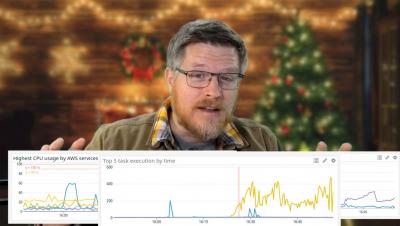
We try to automate as much as possible in our environments, but we often treat monitoring as an afterthought. In this episode of Stack Doctor, we show you how to automate your monitoring configurations via Terraform. Watch to learn how you can automate the creation of common resources - such as uptime checks, alerting policies, and dashboards - with Terraform!

Calculating IOPS Utilization for EBS Volumes

When looking at an EBS volume in CloudWisdom, you’ll notice that in addition to the metrics we collect from AWS, we also create a number of computed metrics, one of which is netuitive.aws.ebs.iopsutilization. Simply put, IOPS Utilization compares the current number of IOPS that the disk is performing against the total IOPS capacity, and expresses this as a percentage. Thus, if you are currently running 1050 IOPS against a volume whose capacity is 3000 IOPS, the IOPS Utilization would be 35%.

Node.js Microservices: Developing Node.js Apps Based On Microservices

Node.js application developers, in the ever-evolving business landscape, enjoy tangible advantages while incorporating microservices in Node.js apps development. The microservice architecture, or microservices, is a distinct method of software systems development, which attempts to create modules that are single-function, with well-defined operations and interfaces.

Kubernetes vs. Docker

Kubernetes and Docker each play a vital role in modern, microservices-based application development. Since Kubernetes and Docker work in unison to help develop, deploy, and manage large-scale applications – they are not mutually exclusive technologies and they are certainly not in competition with each other. Nevertheless, Kubernetes and Docker are often misunderstood by the non-developer community. To clear up the confusion around Kubernetes vs. Docker, we’ve written this guide.

LogicTalks - How Harvard Gained Visibility and Operational Confidence through Monitoring

In this episode of LogicTalks, Mark Banfield, Chief Revenue Officer at LogicMonitor, is joined by Ken Perry, Product Manager and Technology Monitoring Architect at Harvard University to discuss how LogicMonitor has shifted Harvard's monitoring strategy. Ken explains how LogicMonitor has helped to break down monitoring silos between departments, solve unique challenges and use cases within such a large organization, and how LogicMonitor aided Harvard in it's transition to remote learning during the COVID pandemic all while helping to build operational confidence throughout Harvard and it's leadership.

Architectural decisions that impact Kubernetes costs

One of the mistakes organizations make related to Kubernetes costs is addressing them primarily after-the-fact, once the application is running successfully. There are certainly changes that can be made to improve efficiency once the application is running, but cost-control measures are best considered at the beginning, not middle or end, of the application lifecycle.

Understanding the Complete Cloud Cost of Kubernetes

When organizations think about the relationship between Kubernetes and cloud costs, they often focus on Kubernetes’ auto-scaling capabilities and what this means for optimizing compute resources. Kubernetes does allow organizations to provision compute resources more thinly, because the platform allows them to scale up automatically if there’s a demand spike in the middle of the night.