Operations | Monitoring | ITSM | DevOps | Cloud

The latest News and Information on DevOps, CI/CD, Automation and related technologies.

Civo Navigate London 2026 Wrap-Up

This week marks the end of our fourth Civo Navigate London event, and it feels like a good moment to say that this one had a slightly different energy from the ones before it. Over the past four years, we have hosted 10 Civo Navigate events across North America, India, and Europe, and each one has taught us something new about what this community actually wants from a day like this. London 2026 was no exception, and I think this year's lineup pushed that a little further than usual.


Stop capping your best people.

Somewhere in your company, a team is three weeks into the AI project that’s going to matter. Somewhere else, a support pilot from the spring is still summarizing every ticket with a frontier model, and nobody has looked at it since it started working. On the invoice they’re identical, and the company has two moves: leave everything open, which funds the waste, or cap everyone, which kills the bet.

AI finally plans like every other line in my budget

September is associated with football, foliage, flannel and, for some, the Financial Plan. As we put pen to paper (or agents to harnesses), there’s a few core elements that have always driven the P&L outlook for the following year: rep productivity and new product releases driving new sales, expansion and contraction against the install base, employee roster changes, and discretionary spend.
Sponsored Post

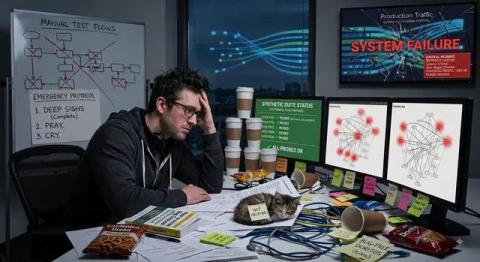
Synthetic Monitoring Is Broken. Your Production Traffic Can Fix It.

Synthetic monitoring has been a critical part of application reliability for years. It gives engineering and operations teams a way to proactively test applications, APIs, and critical customer journeys before users encounter problems. But there is a fundamental limitation with the traditional approach: Someone has to create the tests. As applications become more distributed and customer journeys become more complex, organizations can end up maintaining hundreds or even thousands of synthetic scripts. Every new feature, API, dependency, or change to a customer journey can require another update.

17: There's No Life Without AI: Agents, MCP, and the Future of Automation With Viktor Farcic

On this episode of Kubex Talks, technology critic Viktor Farcic returns to talk with Andrew Hillier about the rapidly changing landscape in tech. Viktor has gone from AI skeptic to believer, claiming that there really is no life without AI anymore, from a professional standpoint.

Best LLM inference providers 2026: 16+ on cost per outcome

An LLM inference provider hosts open-weight models like Llama, DeepSeek, and Qwen behind a pay-per-token API, handling GPUs, scaling, and serving for you. The same Llama 3.3 70B model ranges from $0.10 to $1.04 per million input tokens depending on who serves it, so provider choice is a pricing decision. Top picks as of September 2026: Groq and Cerebras for speed, DeepInfra for price, Together and Fireworks for breadth, Baseten for custom models.

Self-Improving Agents: A Practical Guide to Continuous Learning

We build agents to take work off engineers’ plates. Then we give those engineers a new manual job: reading failed runs and babysitting prompts. Agents will improve themselves automatically. We’re not there yet, but this is the future I’m betting on. We’ve been working on this ourselves at Komodor over the past year. We know how hard it is to turn a failure into an improvement that holds up beyond a few examples.

Incident Management System: What It Is and How to Choose One

An alert fires. A ticket opens. Someone gets paged. Then the real work begins: gathering context, finding the affected service, deciding who owns the issue, running diagnostics, applying a fix, validating recovery, and documenting the result. Many IT teams assume that an incident management system is simply the application that opens and tracks the ticket. That is part of the job, but it’s not the whole operating model.