Operations | Monitoring | ITSM | DevOps | Cloud

Drain the Data Swamp! Tagging your Data in a Data Lake to help Organize and Optimize Search

Sending events into a data lake can make it challenging to find and organize them. Using tagging with Cribl Lake in conjunction with Cribl Search across a primary data source will increase speed of analysis and reduce costs, as well as help keep your data organized. This scenario involves us performing an investigation for an incident that occurred where our systems indicated unusual activity from an IP address of aaa.bbb.ccc.ddd.

Grafana Beyla: what's new and what's next for the open source eBPF auto-instrumentation tool

It’s been a year since Grafana Labs announced the general availability of Grafana Beyla, our open source OpenTelemetry and Prometheus eBPF auto-instrumentation tool to help you easily get started with application observability. As a Beyla maintainer, I wanted to take a minute to reflect on what we’ve accomplished with Grafana Beyla since then, what we have learned about supporting an eBPF tool in production, and, in general, how exciting this whole journey has been.

Ask the Expert: Insights from Paula Thrasher, Senior Director of Infrastructure and Platform, PagerDuty

In this blog post, Paul Thrasher, Senior Director of Infrastructure and Platform at PagerDuty, provides her takes on the challenges and opportunities facing tech leaders today. From managing complexity to driving operational resilience, Thrasher shares expert insights on how executives can get ahead of disruptions.

Reduce application exploitation opportunities with cloud endpoint security protection

It’s no surprise to say that today’s digital business environment is incredibly dynamic. And the proliferation of distributed devices and applications has been a key part of that. The problem this has created? An increased exploitation of endpoint applications, jeopardizing data security and disrupting operations. Yet companies have limited security resources for coping with these risks. But businesses can mitigate them by moving to the cloud.

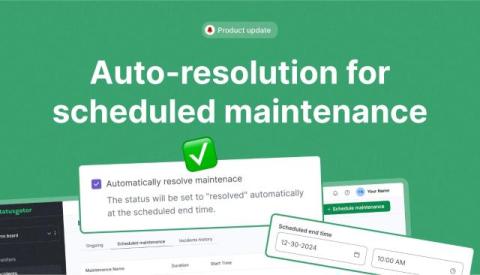
Auto-resolution for scheduled maintenance

We’ve been listening to your feedback, and we’re excited to roll out the new Automatic Maintenance Resolution feature! Now, when you schedule maintenance, your service status will automatically update to “Resolved” at the scheduled end time, and any affected monitors will also switch back to “UP.” This makes managing your maintenance events even easier, without the need for manual updates.

Manage Your Pino Logs with AppSignal

We're excited to announce that AppSignal now supports Pino logs, making managing and monitoring your logging data easier than ever. By sending Pino logs directly to AppSignal, you can consolidate all your data in one place, giving you a clear overview of your app's performance for faster troubleshooting. Importantly, AppSignal now also works with Fastify 5, making it a great choice for Fastify developers looking for an APM that integrates seamlessly with their stack.

Sequential-storage Efficiently Store Data in Flash

While using a full-blown filesystem for storing your data in non-volatile memory is common practice, those filesystems are often too big, not to mention annoying to use, for the things I want to do. My solution? I’ve been hard at work creating the sequential-storage crate. In this blog post I’d like to go over what it is, why I created it and what it does.

Enabling Out-of-the-Box Performance Insights in Unity Games with the Sentry SDK

The Sentry Unity SDK has been effective for crash reporting, including: We are confident that we have the best crash-reporting solution out there. Now we were looking towards offering some out-of-the-box insights into the game’s performance. Right out of the gate, we hit the first question: What would auto-instrumentation for Unity games look like?