Operations | Monitoring | ITSM | DevOps | Cloud

Why it's important to upgrade your Mattermost Server

Upgrading your Mattermost server involves a bit of research, preparation, and downtime. The pressure to keep your Mattermost instance healthy and reduce downtime for a core system within your organization can be intimidating. Recently, we worked with a handful of customers who were experiencing issues upgrading from Mattermost v5.37 and v5.39 to v6.x. Unfortunately, migration scripts were required to make significant database changes, and there was an issue in product performance.


Making Sure the Future of Federal Work Is Secure and Enjoyable - Why We're Partnering with NIST on Its Zero Trust Project

Last year, we announced our partnership with the National Cybersecurity Center of Excellence (NCCoE) at the National Institute of Standards and Technology (NIST) to work on the Implementing a Zero Trust Architecture project. After a year of collaboration with its industry partners, including Ivanti, NIST recently released its preliminary draft, NIST Cybersecurity Practice Guide SP 1800-35 Vol B, for public comment.

How to Overcome Datadog Log Management Challenges

Datadog has made a name for itself as a popular cloud-native application performance monitoring tool, measuring a system’s health and status based on the telemetry data it generates. This telemetry includes machine-generated data, such as logs, metrics and traces. Cloud based applications and infrastructure generate millions (even billions) of logs – and analyzing them can generate a wealth of insights for DevOps, security, product teams and more.

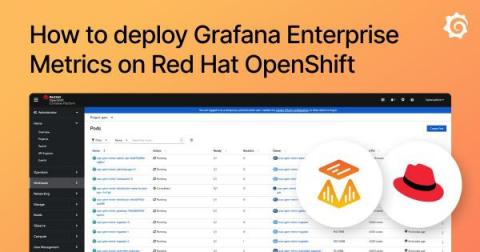
How to deploy Grafana Enterprise Metrics on Red Hat OpenShift

Here at Grafana Labs, we’re always looking for ways to provide our customers with a choice of platforms where they can run Grafana Enterprise Metrics (GEM). As part of that mission, we’re pleased to announce that we’ve added Red Hat OpenShift 4.x support to GEM. GEM, as you may know, is a leading enterprise metrics solution.

Code signing: securing against supply chain vulnerabilities

When creating an application, developers often rely on many different tools, programs, and people. This collection of agents and actors involved in the software development lifecycle (SDLC) is called the software supply chain. The software supply chain refers to anything that touches or influences applications during development, production, and deployment — including developers, dependencies, network interfaces, and DevOps practices.

What Are Semantic Conventions in OTEL?

OpenTelemetry (OTEL) is a big data platform that enables the collection and analysis of large-scale telemetry data. Many companies have adopted it for use in their products. In this post, we’ll discuss semantic conventions in OpenTelemetry and how they are used to make data processing easier. We’ll also discuss the different types of semantic conventions and their importance.

The Journey to Intelligent Payment Operations

In today’s payments ecosystem, the ability to monitor and use payment data effectively represents a real and essential competitive advantage. Intelligent operations should be a strategic goal for the entire company, and when executed properly, will enable you to build a future-proof payment operations infrastructure.

Data Observability Explained: How Observability Improves Data Workflows

Organizations in every industry are becoming increasingly dependent upon data to drive more efficient business processes and a better user experience. As the data collection and preparation processes that support these initiatives grow more complex, the likelihood of failures, performance bottlenecks, and quality issues within data workflows also increases.

Six Tips to Getting SEO Right For Your MSP

When prospects do a Google search on your MSP, where do they find you? Is your MSP landing on Page 1, or is it being relegated to Page 2 or even worse? According to quicksprout.com, the top result on Google has a 33% chance of getting clicked, and they have found that 75% of people won’t scroll beyond the first page. (I know I never do—if what I’m looking for can’t be found on Page 1, why bother even seeing what is on Page 2?)