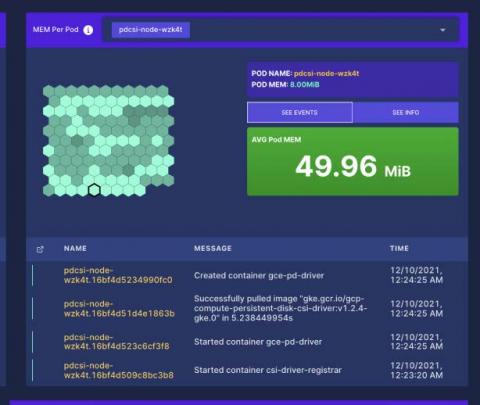
Today, just in time for Kubecon 2021, I am happy to announce the beta availability of Workflows. For me, this is our most exciting product announcement to date – a completely new capability that expands the definition of what Komodor is, as it charts the course for its next evolution. Let me start with the feature first. In a nutshell, Workflows is a series of smart algorithms that operate within the “depths” of Komodor.
In today’s digital world, almost every business is driven by technology, whether big or small. With the advancement of technology, the associated threats to the security of the IT infrastructure come hand in hand. Therefore, businesses need network traffic analysis tools to keep an eye on their network. Monitoring network traffic continuously gives a business the insight to optimize and manage performance, minimize attack surfaces, intensify security, and better manage its resources.
In episode 2 of Network AF, meet Nina Bargisen. Nina has spent over two decades in network engineering and talks to podcast host Avi Freedman about her history in interconnection and peering. She’s worked for companies like Netflix and TDC (formerly Tele Danmark Communications). Now Nina is Kentik’s director of GTM strategy focused on supporting service providers. Nina joins Avi on the Network AF podcast to discuss: Nina’s entry into networking was non-standard.
Financial institutions and their service providers have traditionally owned and run their technology infrastructure on their own premises or in their own data centres. However, that’s changing with the advent of powerful public cloud services, such as Amazon Web Services, Google Cloud and Microsoft Azure.
Catchpoint is proud to present the top SRE tools as voted on by SREs. In our fourth annual SRE Survey, compiled in partnership with VMware Tanzu Observability and DevOps Institute, we simply asked, “What are a few tools that every SRE should have available in their toolbelt?” Today, we are excited to share the findings with you. While some of the answers were not strictly tools, the analysis gives us valuable insight into the mindset of an SRE.
There’s an incident. Your teams need to communicate with the development team that owns the service, but that team is too busy to stop and chat. Meanwhile, you in central IT have business leaders asking for updates, angry internal users calling the help desk, and customer service representatives asking for information. You have hundreds of tickets all pertaining to the incident in your ticketing system.
Non-Fungible Tokens, or short NFTs, are all the rage right now. Everyone and their pets are starting an NFT project. Some people got rich from using NFTs; others did not. Some say it’s the savior that will rip the power away from big corporations and give it back to the creators; others say it’s just a giant pyramid scheme.
Shipa can be deployed on most Kubernetes environments (EKS, GKE, AKS, OKE, Linode, minikube and so on). How about k3s? Let us try to deploy WordPress on k3s cluster using Shipa. We are going to use k3d to create a k3s Kubernetes cluster.