Operations | Monitoring | ITSM | DevOps | Cloud

Announcing Support for DISA STIGs in Puppet Comply

I’ve got some exciting news! With the recent release of Puppet Comply 1.0.2, we’re providing the ability to assess Windows 2016 servers against DISA STIGs, required security standards for companies that do business with the U.S. Department of Defense. This new capability makes it drastically easier for organizations to assess and demonstrate compliance with DISA STIGs.

Hafnium Hacks Microsoft Exchange: Who's at Risk?

Microsoft recently announced a campaign by a sophisticated nation-state threat actor, operating from China, to exploit a collection of 0-day vulnerabilities in Microsoft Exchange and exfiltrate customer data. They’re calling the previously unknown hacking gang Hafnium. Microsoft has apparently been aware of Hafnium for a while — they do describe the group’s historical targets.

Top 7 Datadog Competitors to Know in 2021

Datadog was founded in 2010 by Olivier Pomel and Alexis Le-Quoc. They develop the Datadog to reduce the friction they experienced between system administration teams and developers. Together they raised over $648 million to bring its valuation to $7.8 billion by the end of 2019. Let’s dig deep into Datadog to know its competitors.

Introducing custom user statuses

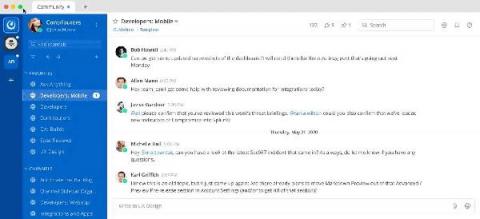
Users now gain the flexibility to express their current status in any way they prefer. Set a custom status to add a descriptive status message and emoji that’s visible to everyone throughout the app. Custom user statuses are available in Mattermost Cloud today and in Mattermost Self-Managed v5.33 (available March 16), with mobile support coming soon.

5 Universal Steps to Cloud Database Migration

Chances are if you’re reading this, you are (or are thinking about) moving to cloud. While cloud migration isn’t a new term and many people are migrating, there are a few things you should know before taking the leap. Migrating your database to the cloud is worth the hours of planning, sorting through data and running tests because if it’s not done right, it may come with more bad than good.

How to manage Elasticsearch data across multiple indices with Filebeat, ILM, and data streams

Indices are an important part of Elasticsearch. Each index keeps your data sets separated and organized, giving you the flexibility to treat each set differently, as well as make it simple to manage data through its lifecycle. And Elastic makes it easy to take full advantage of indices by offering ingest methods and management tools to simplify the process.

How to speed up incidents with a lot of cooks in the kitchen

In one of our recent webinars we discussed a substantial challenge IT Ops teams face in today’s complex IT environments: defining and clearly communicating incident/operational roles and processes, in an effort to create a well-coordinated incident management lifecycle. This lifecycle is essential for restoring service as quickly as possible when disruptions occur. Following are the highlights of that discussion, also recently published in an ApmDigest article.

9 Barriers to DevOps Implementation

The DevOps model unites development and IT operations to create a powerful organizational culture to achieve business goals more efficiently. Formerly siloed teams can now collaborate continuously to build more robust products, with increased confidence, and achieve business goals faster. The model has the power to transform operations, but there are barriers to DevOps that must be overcome first.

Are NoSQL Databases Relevant For Data Engineering?

SQL is great, but sometimes you may need something else. By and large, the prevalent type of data that data engineers deal with on a regular basis is relational. Tables in a data warehouse, transactional data in Online Transactional Processing (OLTP) databases — they can all be queried and accessed using SQL. But does it mean that NoSQL is irrelevant for data engineering?

10 Ways to Get Ahead with OpsRamp's AIOps

IT operations departments in larger enterprises often use 10-15 monitoring tools across different teams to track the health and availability of their core business services. Rather than helping ITOps teams gain a comprehensive view of their infrastructure, an overload of monitoring tools tends to only compound organizational silos and limit insights for incident troubleshooting. Yes, there is too much of a good thing.