Operations | Monitoring | ITSM | DevOps | Cloud

CIS benchmark compliance: Introducing the Ubuntu Security Guide

The CIS benchmark has hundreds of configuration recommendations, so hardening and auditing a Linux system manually can be very tedious. Every administrator of systems that need to comply with that benchmark would wish that this process is easily usable and automatable. Why is that? Manual configuration of such a large number of rules leads to mistakes – mistakes that cause not only functional problems, but may also cause security breaches.
Ubuntu introduces the Ubuntu Security Guide to ease DISA-STIG compliance

January 17th: London, UK – Canonical, the company behind Ubuntu, the world’s most popular operating system across private and public clouds, now offers the Ubuntu Security Guide tooling for compliance with the DISA Security Technical Implementation Guide (STIG) in Ubuntu 20.04 LTS. The new automated tooling builds on Canonical’s track record of designing Ubuntu for high security and regulated workloads, powering U.S. government agencies, prime contractors, and service providers.

Telegraf Best Practices: Config Recommendations and Performance Monitoring

Telegraf has reached the ripe old age of V1.21.2. Thanks to community feedback and contribution, there have been many features added over the years. Lately, I have seen these questions pop up. If any of these questions plague your mind, have no fear — this blog is here to help! Here are my golden rules for maintaining best practices when building your Telegraf solution.

The optimum page speed for your website and how to achieve it

Website page speed has become more important than ever, especially now Google’s Core Web Vitals are pushing mobile-first and penalising websites it deems to be “too slow”. This means that there is a direct link between slow page speed and lower SEO rankings, and therefore potentially, less traffic to your website.

DevOps State of Mind Episode 7: How AI and ML Can Empower Your Developers

Nick Durkin is the Field CTO and VP of Field Engineering at Harness, where he focuses on solving the technical challenges that are standing in the way of true innovation. Today, we're talking about how Harness uses AI and ML to remove the most annoying parts of your job so that you can focus on what you do best.

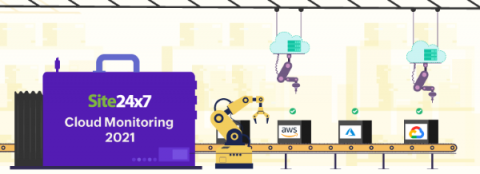
The growing demand for multi-cloud monitoring and Site24x7's featured releases: 2021

Catalyzed by the pandemic, 2020 and 2021 witnessed an exponential growth in digital transformation and cloud computing. According to Forbes, this growth is expected to continue in 2022. Site24x7 added more integrations and features to its cloud monitoring portfolio to keep up with the business trends and enterprise demands. Let's dive deep into Site24x7's multi-cloud monitoring releases in 2021 and shed some light on what you can expect from us in 2022.

How To Select The Right NaaS Partner

The end-goal for a CIO adopting a Network-as-a-Service (NaaS) approach is to create a predictable, cloud-like consumption model for enterprise infrastructure. NaaS is designed to ensure that the enterprise network is state of the art and continually adopts innovations, frees the enterprise IT staff from monitoring tasks, rolls up the range of SLAs, and reduces the need for specialist skills in-house.

What Is Load Balancing

Load balancing means splitting up network traffic so that you can distribute it evenly across a group of backend servers. For example, if you run two web servers, both hosting a copy of the same website, then you can balance the traffic across them, sending half to one and half to the other. The goal of load balancing is to increase the availability of your website or web-based application by routing a portion of requests to each server.