Operations | Monitoring | ITSM | DevOps | Cloud

Introducing monthly site reports

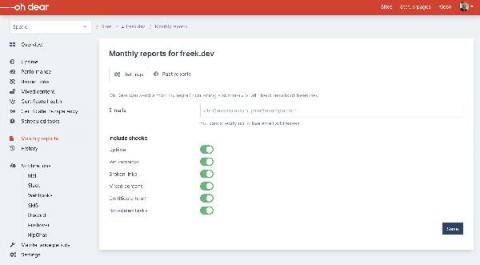
Today, we're introducing a new major feature: monthly site reports. In such a report, you got a bird's eye summary of everything we know of a site in a particular month. We've gone the extra mile and added the ability to mail these reports to people outside of your team automatically. If you're an agency and manage sites for your clients, you could use this feature to send a monthly report of all broken links to your client. In this blog post, we'll tell you all about the feature.

Improving Node.js Application Performance With Clustering

When building a production application, you are usually on the lookout for ways to optimize its performance while keeping any possible trade-offs in mind. In this post, we’ll take a look at an approach that can give you a quick win when it comes to improving the way your Node.js apps handle the workload. An instance of Node.js runs in a single thread which means that on a multi-core system (which most computers are these days), not all cores will be utilized by the app.

How to use Sentry Attachments with Mobile Applications

In a previous life as an Android developer, a customer reported a nasty bug that we didn’t know how to fix. After what felt like countless hours of debugging and writing back and forth to customer support, our only option left was to get our hands on the users’ local database. However, for a variety of reasons, we couldn’t ask the customer to root the device, copy the database, and send it to us.

Facter 4: back to the roots

Facter is a cross platform system profiling tool. It gathers nuggets of information about a system such as its hostname, IP address and operating system. We call these nuggets of information facts and they are used by other Puppet products like Puppet, Puppet Server and Bolt to make decisions in their automation process. You can extend Facter by writing custom facts or external facts and use them in Puppet manifests.

Martello in Motion - University of New Hampshire

Founded in 1866, the University of New Hampshire (UNH) is a public research university with its main campus spread across 2,600 acres in Durham, New Hampshire. For more than 154 years, UNH has delivered hands-on learning, research, and work experiences that bring together students, faculty, and private and public partners to create life-changing opportunities and innovative solutions across the world.

Datadog On eBPF

eBPF (extended Berkeley Packet Filter) is a Linux technology that can run sandboxed programs in the kernel without changing kernel source code or loading kernel modules. While the kernel is an ideal place to implement monitoring/observability, networking, and security it wasn't until the recent broad adoption of eBPF that it was feasible. Datadog has embraced the possibilities that eBPF brings in those areas and there are several teams already using eBPF in their products.