Operations | Monitoring | ITSM | DevOps | Cloud

The latest News and Information on Distributed Tracing and related technologies.

How to Use OpenTelemetry & JavaScript Together: A Tutorial

This post was written by Siddhant Varma. Scroll down for the author’s bio. Observability is an essential aspect of a healthy software architecture and a highly performant system. It enables developers and engineers to understand and dive deeper into how their application behaves. This in turn helps them monitor it effectively.

Developing with OpenAI and Observability

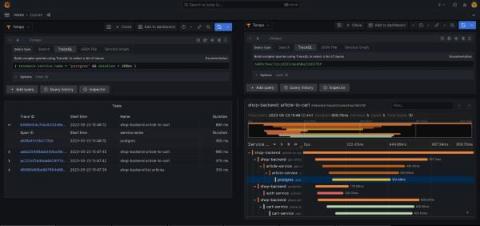
Honeycomb recently released our Query Assistant, which uses ChatGPT behind the scenes to build queries based on your natural language question. It's pretty cool. While developing this feature, our team (including Tanya Romankova and Craig Atkinson) built tracing in from the start, and used it to get the feature working smoothly. Here's an example. This trace shows a Query Assistant call that took 14 seconds. Is ChatGPT that slow? Our traces can tell us!

An Introduction to Using OpenTelemetry & Python Together

This post was written by Mercy Kibet, a full-stack developer with a knack for learning and writing about new and intriguing tech stacks. In today’s digital world, software applications are becoming increasingly complex and distributed, making it more challenging than ever to diagnose and troubleshoot issues when they arise.

Coralogix Provides Highly Scalable Traces For Your Success

While more observability vendors are providing tracing ingestion and visualization as part of their core service, only Coralogix, the leading in-stream observability platform, supports a set of data optimization features that drive down cost, maximize insights and create a scalable tracing strategy unlike others.

Monitor Your Applications Through New Relic via OpenTelemetry Over HTTP

As a big proponent of open source and all things open, I jumped at the opportunity to expand on Cribl Stream’s OpenTelemetry implementation. I’m happy to report that as of Cribl Stream 4.1, both our OpenTelemetry source and destination now support OTLP over HTTP!

Errors Got You Down? Honeycomb and OpenTelemetry are Here to Help

It’s 5:00 pm on a Friday. You’re wrapping up work, ready to head into the weekend, when one of your high-value customers Slacks you that something’s not right. Requests to their service are randomly timing out and nobody can figure out what’s causing it, so they’re looking to your team for help. You sigh as you know it’s one of those all-hands-on-deck situations, so you dig out your phone and type the "going to miss dinner" text.

Metrics, Logs and Traces: More Similar Than They Appear?

This article was originally published in The New Stack and is reposted here with permission. They require different approaches for storage and querying, making it a challenge to use a single solution. But InfluxDB is working to consolidate them into one. Time series data has unique characteristics that distinguish it from other types of data. But even within the scope of time series data, there are different types of data that require different workloads.

OpenTelemetry Tutorial: Collect Traces, Logs & Metrics with InfluxDB 3.0, Jaeger & Grafana

Here at InfluxData, we recently announced InfluxDB 3.0, which expands the number of use cases that are feasible with InfluxDB. One of the primary benefits of the new storage engine that powers InfluxDB 3.0 is its ability to store traces, metrics, events, and logs in a single database. Each of these types of time series data has unique workloads, which leaves some unanswered questions. For example: Luckily this is where our work within OpenTelemetry comes into play.