Operations | Monitoring | ITSM | DevOps | Cloud

The latest News and Information on Serverless Monitoring, Management, Development and related cloud technologies.

Three serverless reliability risks you can solve today using Failure Flags

Serverless platforms make it incredibly easy to deploy applications. You can take raw code, push it up to a service like AWS Lambda, and have a running application in just a few seconds. The serverless platform provider assumes responsibility for hosting and operating the platform, freeing you up to focus on your application. Naturally, this raises a question: if something goes wrong, who’s responsible?

Office Hours: How to test serverless applications using Failure Flags

Part of the Gremlin Office Hours series: A monthly deep dive with Gremlin experts. Serverless applications are ideal for deploying scalable applications without having to manage infrastructure. However, this also makes it difficult to test their reliability. It’s easy to simulate a network outage or latency when you have direct access to the host that your software’s running on. What do you do when you only have control over the code?

Making serverless applications reliable and bug-free

Building applications using serverless technology on AWS—like AWS Lambda and Amazon API Gateway—can be incredibly powerful. You get to scale effortlessly and focus on writing code without worrying about managing servers. But as your application grows and spreads across hundreds or even thousands of cloud resources, keeping track of errors and fixing issues quickly becomes a big challenge.

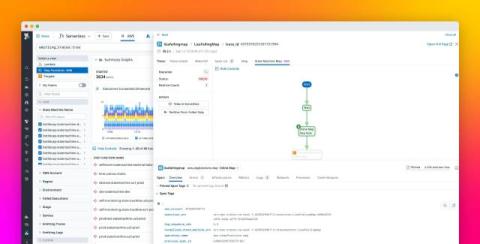
Reduce your AWS Step Functions' error remediation time by redriving executions directly from Datadog

AWS enables customers to retry or redrive Step Functions executions to continue any failed executions of Standard Workflows from their points of failure while maintaining all inputs. For example, if you find broken downstream logic in your code or experience unexpected errors upon execution, you can remediate those errors by fully re-running an execution or use redrive to continue this execution.

Why OpenSearch Serverless is a Game-Changer

AWS OpenSearch Service is a fully managed service supplied by Amazon Web Services (AWS) for deploying, managing, and scaling OpenSearch clusters in the cloud. OpenSearch Service was formerly known as Amazon Elasticsearch Service (Amazon ES) but was renamed in 2021 due to changes in the open-source project it is based on. In 2022, AWS OpenSearch Serverless was announced.

Build and deploy a Dockerized OpenCV application on AWS Lambda

OpenCV is a powerful open source computer vision and machine learning software library for real-time applications. It provides multiple functionalities, including image processing, object detection, and video analysis, making it a fundamental tool for researchers and developers in the field of computer vision. You can deploy your OpenCV applications using AWS Lambda, a serverless compute service that lets you run code without provisioning or managing servers.

How to Design and Create Cloud-Native Applications for Data Analysis

Are you a data scientist, analyst, or IT professional seeking to leverage cloud computing for your data analysis projects? We understand your challenges in managing large datasets, scaling your analysis, and maintaining cost-effectiveness. This guide will walk you through designing and creating cloud-native applications for data analysis. By the end of this article, you'll have a clear roadmap for building robust, scalable, and efficient cloud-native data analysis applications that can transform your organization's data capabilities.

Unlocking Speed and Efficiency: The Benefits of Serverless Infrastructure for SEO

In the ever-evolving digital landscape, website speed has become a critical factor in SEO performance. Faster page load times not only enhance user experience but also contribute significantly to better search engine rankings. One of the most promising advancements in this area is the adoption of serverless infrastructure. This approach, which eliminates the need for traditional server management, has emerged as a game-changer for web performance, particularly for SEO. Let's delve into how serverless infrastructure is transforming website speed and SEO, with insights from an industry expert.