
Operations | Monitoring | ITSM | DevOps | Cloud

Self-Healing Endpoints with DEX | Ivanti

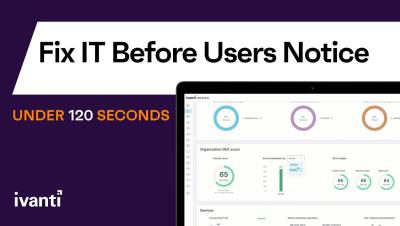
Digital employee experience shouldn't just be a metric — it's the result of how well endpoints are managed, secured, and remediated in real time. In this teaser, see how Ivanti transforms reactive IT into proactive, autonomous operations. Today's IT teams are stuck in reactive mode. Employees suffer through slow laptops, dropped VPN connections, and crashing apps — and most never report it. Ivanti Neurons for Digital Experience (DEX) changes that by monitoring real-time DEX scores across devices and user groups to uncover issues before they impact productivity.
What Four Leadership Circles Revealed About Operationalizing DEX

Earlier this year, I spent time with technology leaders across four major cities – San Diego, Boston, London and Dallas, as part of four Leadership Circles. Taken together, the conversations reinforced how far digital employee experience has matured for many organizations. The focus has shifted from understanding why DEX matters to exploring what it takes to operationalize its success. San Diego focused on the changing role of IT and the strategic case for DEXOps.

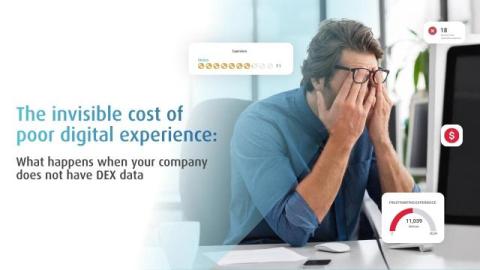
The invisible cost of poor digital experience: what happens when your company does not have DEX data

Your sales team missed an important meeting because a laptop froze in the middle of the presentation. The finance team recreated a spreadsheet three times because Excel closed by itself. None of these incidents became a ticket. None were recorded. But both cost money. Most companies measure IT health through technical indicators: servers up, systems online, tickets resolved.

AlmaIQ: The Smart Concierge That Revolutionizes IT Support and Productivity

Discover how AlmaIQ, Almaden's conversational artificial intelligence integrated with Collective IQ (ITAM and DEX), is transforming the way teams and employees interact with your organization's technology. AlmaIQ connects users to corporate data, insights, and knowledge through simple natural language conversations, allowing you to diagnose device performance issues, check software status, and get instant answers without hassle.

Autonomous Endpoint Management: From Endpoint Automation to Autonomous DEX

The digital workplace has outgrown the support model built to maintain it. Employees now depend on an mix of devices, applications, AI tools, and connected workflows to get their work done. As this environment becomes more complex, IT is expected to support more technology, control costs, and enable greater productivity. Traditional, ticket-driven support makes that difficult.

What DEX Leaders at Truist and GSK See That Your Dashboard Doesn't

An HR colleague at GSK was having trouble with her screen. The default fix was the obvious one: give her a bigger monitor. She turned it down. What she truly needed was an accessibility tool to magnify what was already on the screen she had. Sarah Jones, Senior Director, Global Site Operations and Executive Services at GSK, shared that example in a recent HR Grapevine feature on Women in DEX, the global collective Nexthink launched in March.

Smarter Device Refresh Decisions with Teneo Managed Digital Employee Experience (DEX)

How do you know which employee devices really need to be replaced? Teneo Managed Digital Employee Experience (DEX) gives IT teams the visibility and data they need to make smarter device refresh decisions based on actual device health and user experience.

Teneo Managed DEX: How to Resolve Microsoft Teams Issues Faster

See how Teneo Managed DEX helps IT teams identify and resolve Microsoft Teams issues faster, often before they become another service desk ticket. In this Managed DEX example, Teneo shows how Digital Employee Experience (DEX) monitoring and automated remediation can help detect a Microsoft Teams problem, take action and get the employee back to work faster. Teneo Managed DEX helps organizations.

DEX Data Is Too Valuable to Limit to IT

For many organizations, digital employee experience (DEX) is still viewed as an IT project. It measures endpoint health, identifies performance issues, and helps service desks resolve incidents faster. While that’s useful, it’s also far too small a vision. In order to get the greatest return from DEX, organizations have to stop treating it as exclusively an engineering capability and started treating it as an equally powerful intelligence capability.