Successful customer service requires connecting the dots across an entire organization’s teams, systems, and data to address customer needs seamlessly and efficiently. A task of this magnitude and facets comes with myriad challenges. Automation, artificial intelligence (AI), and other advanced technologies can help. Let's explore three ways you can use emerging tech to address your customers' needs proactively and effectively.
At incident.io we use gorm.io as the ORM library for our Postgres database, it’s a really powerful tool and one I’m very glad for after years of working with hand-rolled SQL in Go & Postgres apps. You may have seen from our other blog posts that we’re heavily invested in tracing, specifically with Google Cloud Tracing via OpenCensus libraries.
The early days of cloud computing saw people subject it to severe scrutiny. The main talking point revolved around its security and the ability of infrastructure providers to keep it secure. Regardless of the doubts, more businesses are migrating to the cloud. That's mainly because leading cloud service providers have consistently improved and upgraded their processes to secure their networks. However, even with years of improvement, the old fears remain.
When you think of TDD, you might lean towards Test-Driven-Development. Though in Tomasz Manugiewicz’s ACE 2022 talk, the ‘T’ in TDD could also mean Trust e.g Trust-Driven-Development. The talk, boils down to if there is trust, there is autonomy. If there is autonomy, creativity flourishes. Building trust is done incrementally, incremental success builds success. Software engineering is a team sport and an exercise in iteration.
I recently changed teams within Grafana and now I get the chance to work with Grafana Loki, our highly effective open source log aggregation system that stores and queries logs from your infrastructure or applications. At Grafana, we always dogfood our products so what better way to learn more about Loki than trying out a simple use case that I can actually benefit from.
Why are PHP memory limits important to your website development journey? PHP is a famous backend technology that is used by many tech giants for supporting their applications. PHP gives many advanced features for making web pages dynamic and integrating some features you can not simply get using javascript, HTML, and CSS. Whenever you set up a new PHP project, some memory is allocated automatically. This memory is mostly suitable for general applications.
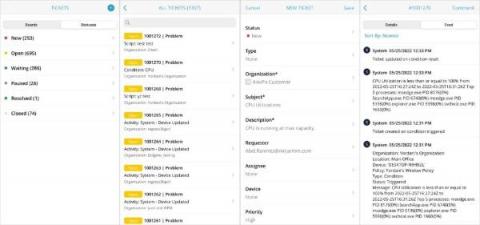
Since the release of Ninja Ticketing, one of our partners’ most frequent requests has been to add ticketing functionality to the Ninja mobile app. Today, we’re excited to announce that the Ninja mobile app now includes key ticketing functionality, including the ability to: This new functionality comes to Ninja on top of existing capabilities for endpoint management, including: App Store or Google Play.
Geo-temporal data has both location and time. It’s used for all sorts of applications, from tracking shipments, to predicting weather patterns, to building fitness apps. It’s powerful because it lets you know where and when events happen, so you can understand them better and connect them with other events.